Project: Meteora
A first person, roguelike-horde shooter
Trailer
Summary
Meteora is a systemically heavy project, being a roguelike horde shooter, taking inspiration from the likes of Black Ops Zombies and the player upgrades found in Risk of Rain 2 items.
Set in a low-poly environment featuring a sci-fi lab along with a close by village, that have fallen under the corporate terror of hostile robots which have gone rogue.
It is up to the player to grow strong through the gathering of items, new weapons and skill to bring an end to the robot terror, and take down C.A.R.M.E.N.
Project Breakdown
Solo - 7 weeks, halftime (4 hours/day)
Created in Unreal Engine 5
All scripts & systems are created by me
The focus of the project is primarily on scripting & system design, accomodated by an addicting gameplay loop, and built on a Figure-8 style level for good flow.
Noteworthy systems:
Economy
Upgradable stats
Unlockable weapons
Randomized shop system
Spawn algorithm & round based logic
Player controller & visual feedbacking
Goals
To create an addictive gameplay loop with clear player progression and side objectives*
Creating replay value through roguelike elements, such as randomizing weapon spawn locations and a shop that randomizes items & stats
Making a visually pleasing low-poly environment with differing “visuals” for the sake of a good player mental map
Assets Used
Blockout Tools plugin by Dimitry Karphukhin
Low Poly Nature by Vertex Rage Studio
Low Poly Sci-fi corridor by PolyArt3D
Sci-fi Weapon Pack by GrayBite Studio
Low Poly Dungeon Props (No longer available on Fab)
Software used
Unreal Engine 5.6
Miro
Krita

Gameplay systems
As previously stated, Project: Meteora is fairly ambitious on the scripting side for a solo project, but I will cover the most important ones here:
Weapon showcase with their respective secondary functions
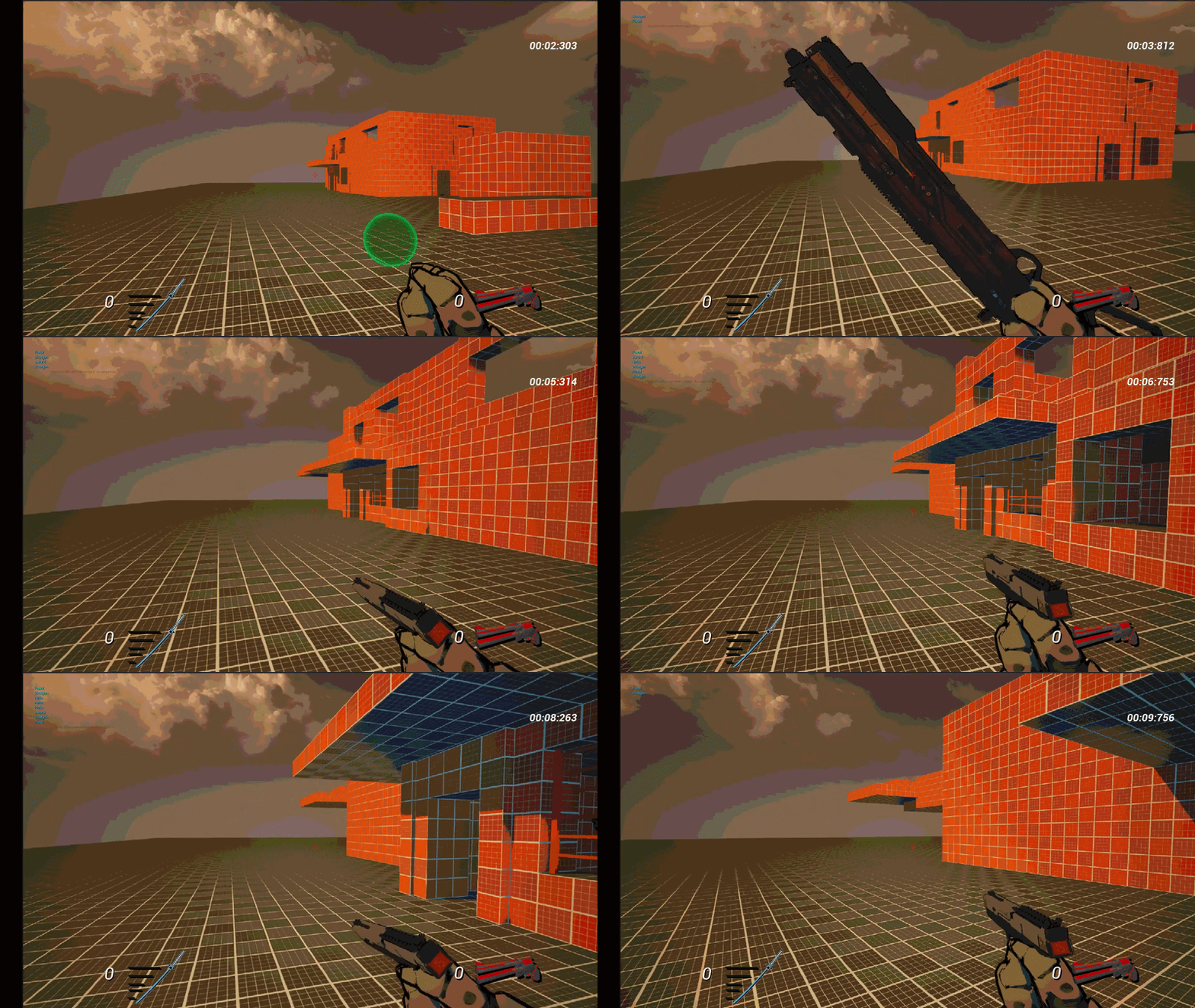
Early stage of weapon swap
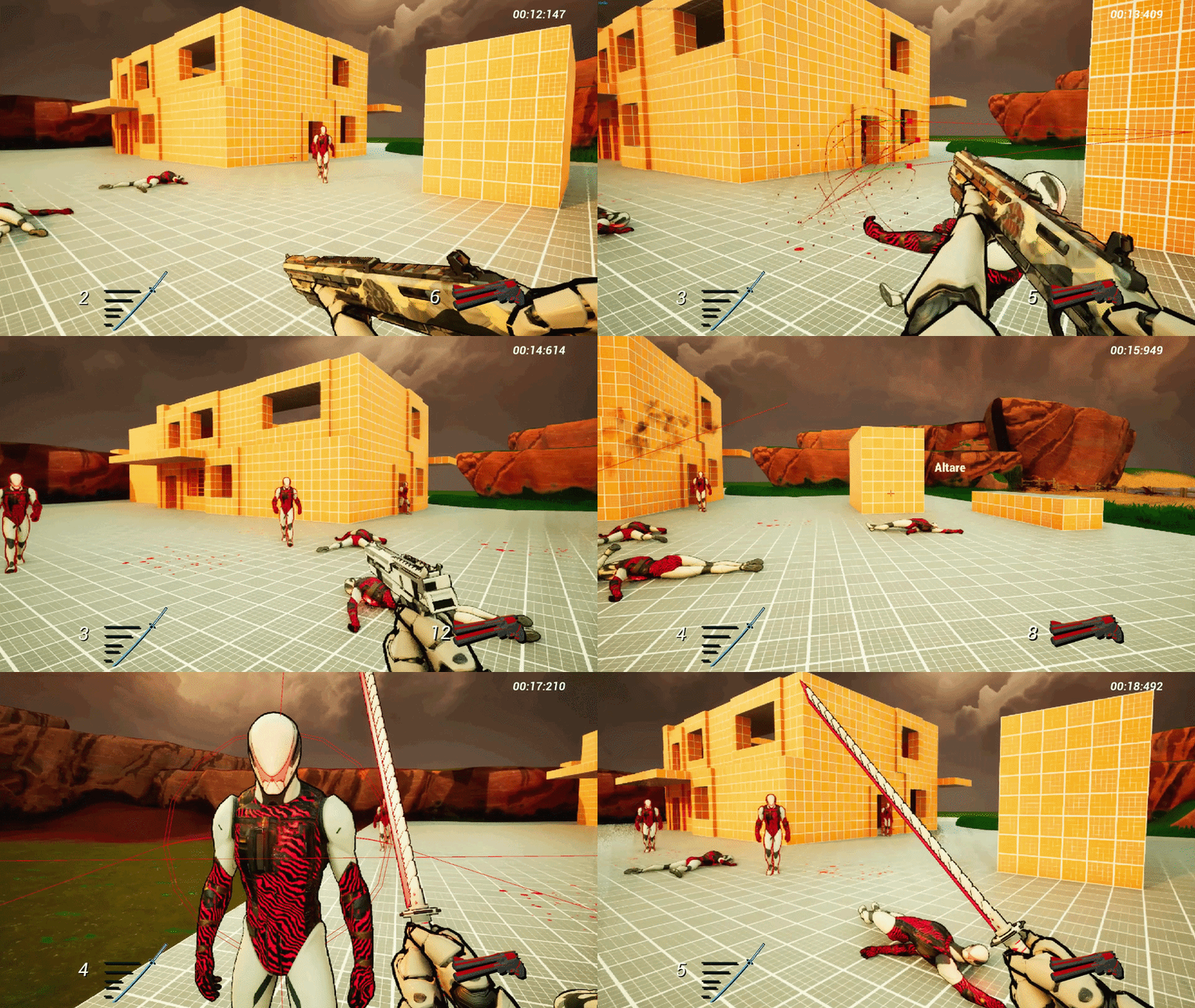
Middle stage of weapon swap
sHOP
The shop is the biggest contributor to the games’ replayability and keeps it exciting to come back for more runs to see how powerful you can become. It is also vital to interact with in order to become strong enough for the boss at the end of each run!
How it works:
You add a row in the Item data table → Give it an icon, Item Index, name, description and stats you want the player to get upon purchasing the item.
Upon interacting with the shop, the player spends their money, the shop will randomly select a row from the data table, and whichever item the player chooses, they will get its stats applied to them, and the shop closes. Transaction complete.
Code embed
Shop interaction
Round system
The game runs on a round based system, what that entails is that every round gets an increasing amount of enemies, as well as incrementing their stats.
Enemies get more health, move speed and damage with each passing round. At first I considered giving them more money upon death, but decided not to, as higher rounds offers you more enemies you will get an increase to the economy regardless.
It also works in a way where the enemies don’t have the exact same stats, what I mean is that some run faster and some have more hp than others.
It makes it feel more dynamic to play and keeps the player on their toes, as you aren’t 100% prepared for what is coming at you. Some shooters will teach you that some enemies will always die in 2 bullets, but that can become mundane when you always know the outcome. That is something I wish to avoid.
Player mechanics
The base player script is fairly simple, consisting of:
A sprint mechanic
Different upgradable weapons
Shooting, reloading and a special secondary function per respective weapon.
Pistol has Single-fire as default, Full-auto as special upgrade
Shotgun has Buckshot as default, Slug rounds as special upgrade
Sword has a melee range attack as default, defensive stance that blocks all damage as special upgrade
Variables such as money and ammo reserves
This puts an in-game focus on resource management and economy
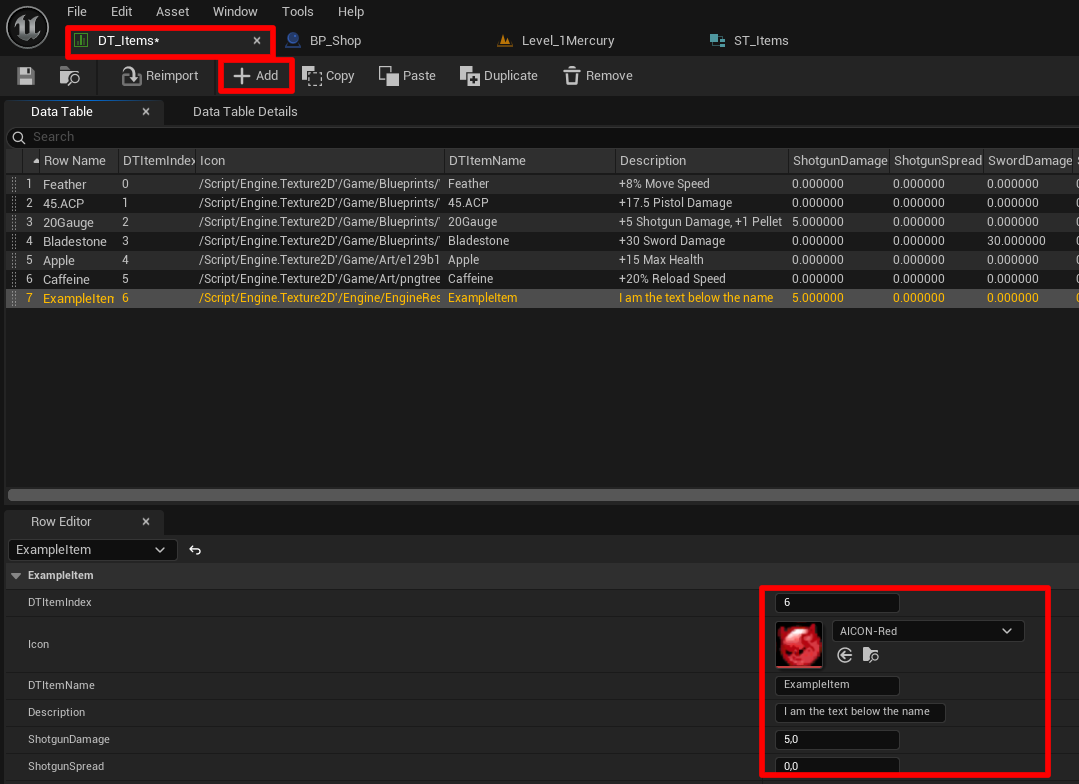
How easy it is to add more items to the shop:
The reason for the shop containing random items:
Knowing exactly where to go on the map only to buy the items you wanted, would become stale and make the overall game flow worse. But making the shop random also keeps the player balanced, and won’t let them stack a single upgrade type that will just ruin the game balance. Sure, you can still roll for that and get it by chance, but then that run would feel special and exciting because you got lucky with the shop. I think that’s a win-win system.
I did however intend from the start to have different shops containing only certain types of items (offensive, defensive etc.) but it felt like a stretch goal I didn’t want to prioritize for the moment being.
weapon unlocks
From the start, I planned on having all 3 weapons unlocked immediately but that felt boring due to lack of meaningful game progression.
I decided to make the other 2 weapons (shotgun and sword) something you earn in-game instead, but I didn’t just want to outright buy them, as that would add more complex layers to the economy and I didn’t want players to hit the shop, only to get shotgun/sword upgrades when they didn’t even own the weapons.
The solution was to create the “soul box”, an object in the level which you have to kill enemies in its proximity of, and when the soul box is fully charged, the player may interact with it to obtain a weapon from it.
There’s 2 soul boxes on the map, one in the courtyard and one in the facility. I contemplated having them deeper in the level, but it can take a minute to unlock the weapons as is, so I decided to only gate them behind one door each.
Which weapon you get from each box is random every run. On Begin Play, it shuffles an array of the two weapon meshes, and whichever mesh is showing in the box is the one the player gets at that location. I think it helps keep every run more interesting, as the early game becomes more of a “use what you get” style of gameplay.
ECONOMY DESIGN
This is also my first project where I’ve made a bigger scoped economy!
Enemies give the player 75 gold on death. In the early game, players have to consider progressing on the map through doors, restocking ammo or hitting the shop.
It can feel scarce at first, but as they go through the run they will find themselves with more and more disposable income. And you will never find yourself with “too much money without anything to spend it on” like certain other games do, which just feels like a suffering from success type of moment.
The player can buy the following in a run:
Doors: 500-1 000 gold depending on how deep they are in the level
Ammo refill: 250 gold
Spin the shop: 750 gold
Special weapon upgrade: 2 500 gold
I think the special upgrade is at a perfect price point. The upgrades feels strong enough to be compared to 3 shop purchases, but its impact feels greater, given they are active effects and not just passive ones. I think it gives the player a heavy decision, to save up the money for a big upgrade, or incrementally get stronger through more, but smaller stat increments.
I’m super happy with how that balancing turned out!
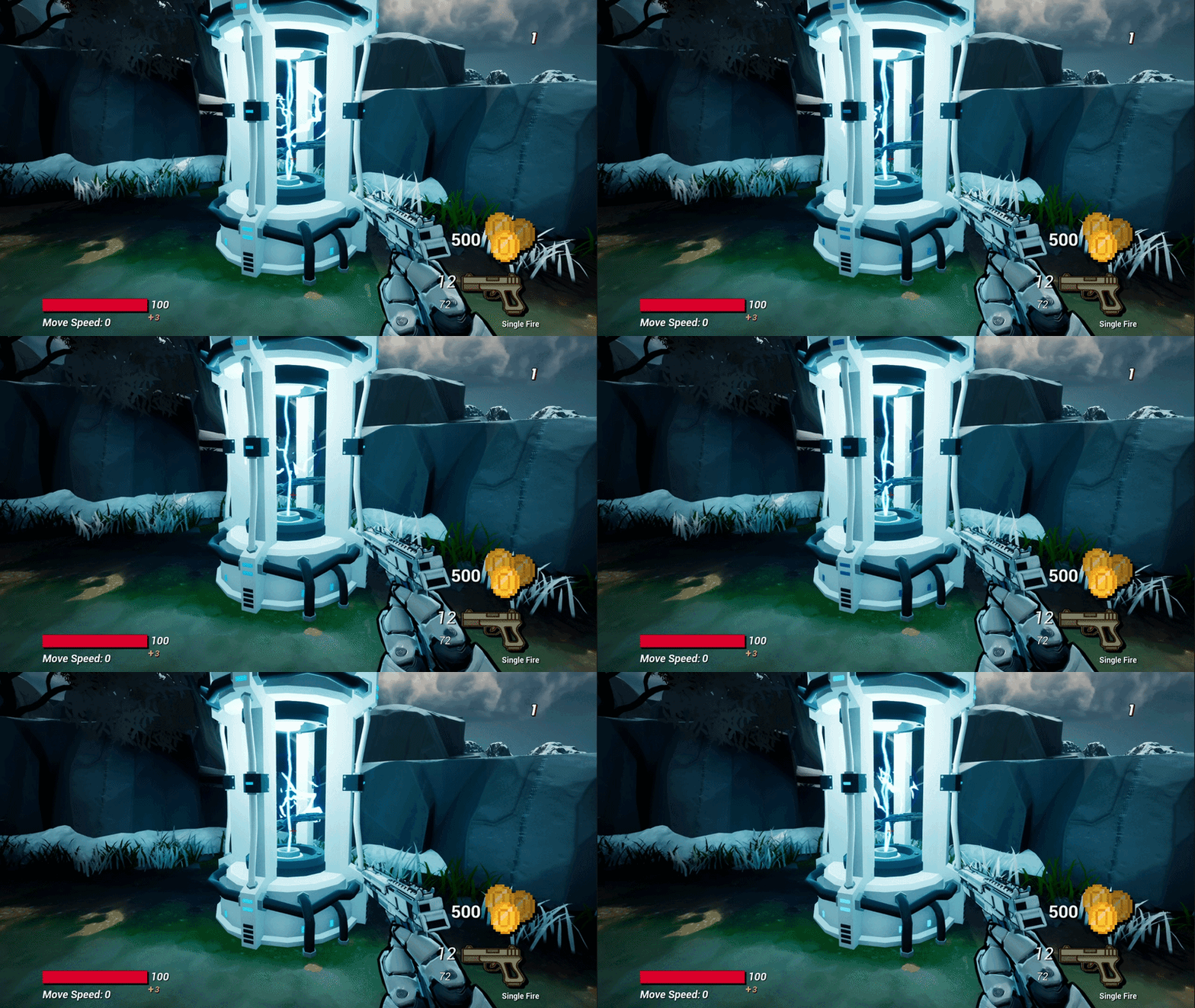
Locked soulbox
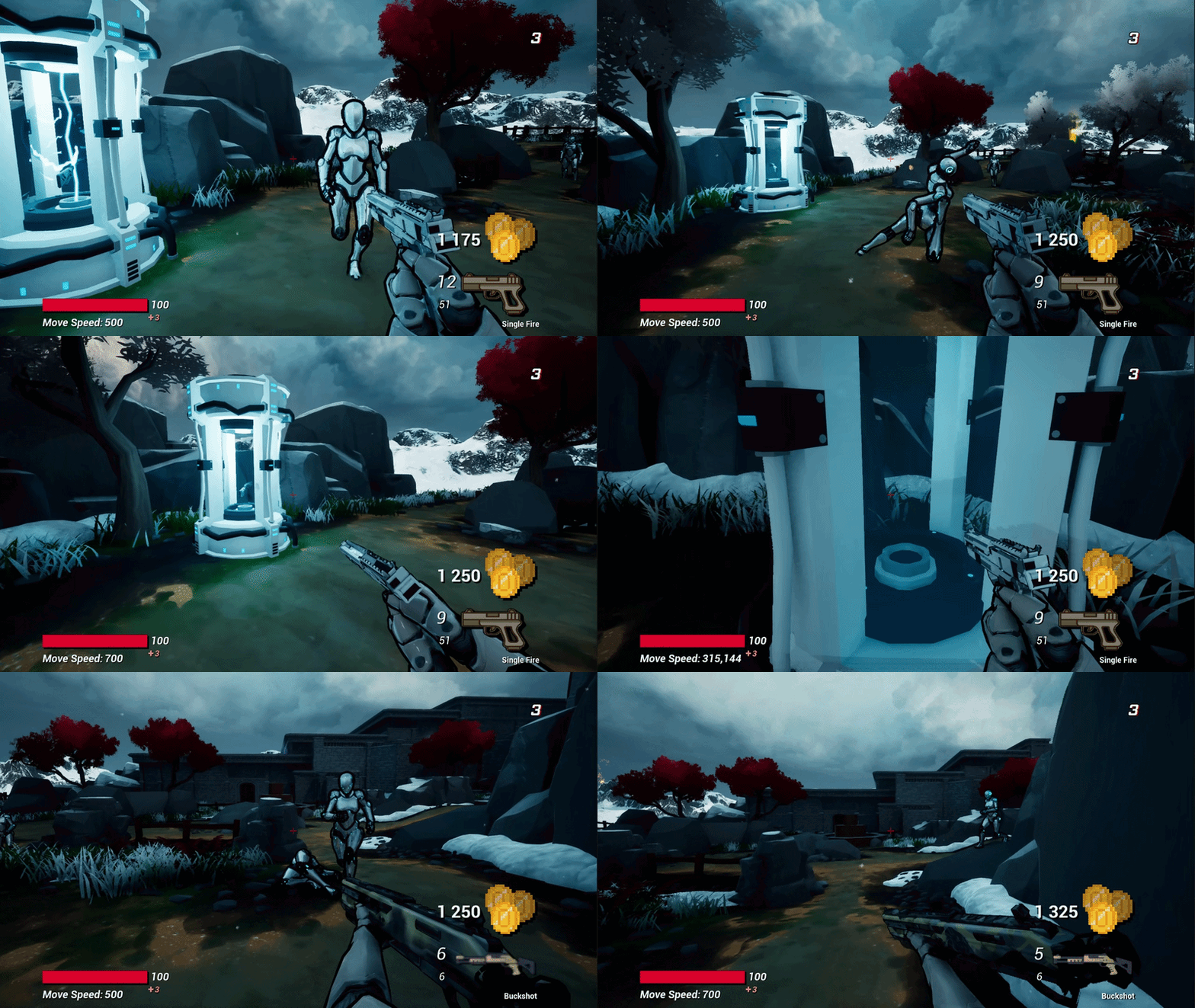
Unlocking the soulbox
Early ideas
Early stages of Meteora went something like: what if I take two of the most addictive kinds of shooter games I know and combine them? After that I just experimented with a simple AI, ramped up the tempo as the game progressed through spawns and enemy stat increments, then tried to make an economy around that.
That’s where I got the idea of items and making a randomized shop, for the player to keep up and have meaningful progression throughout the game.
The absolute first thing I created however was the weapon swapping system. I had never made a system before where you changed weapons in a traditional FPS manner, so it was very exciting to tinker with.
After I figured out the visual swapping, I discovered the magic of using Bytes and enumerations. I got working on different gun logic, single bullet for pistol, buckshot for the shotgun and sphere trace for the sword.
I experimented further with weapon functionality and wanted to make a “Specials” system, where each weapon had a cool secondary use for different use cases. The shotgun and pistol secondaries are quite standard, but I’m very happy with how the defensive stance on the sword turned out. It just feels super cool to block incoming damage at any given moment and it’s my personal favorite Special upgrade to buy in a run!
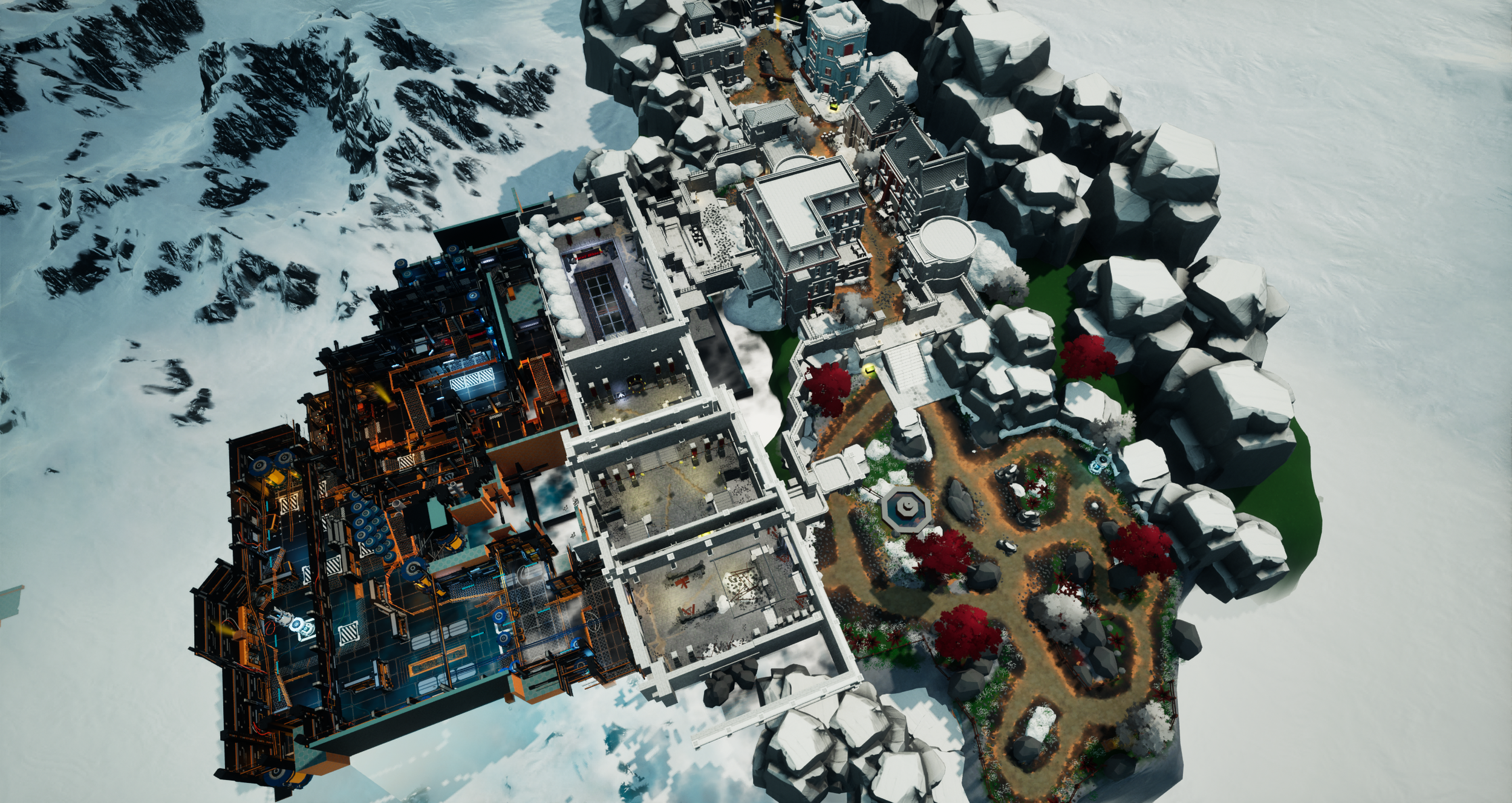
lEVEL OVERVIEW
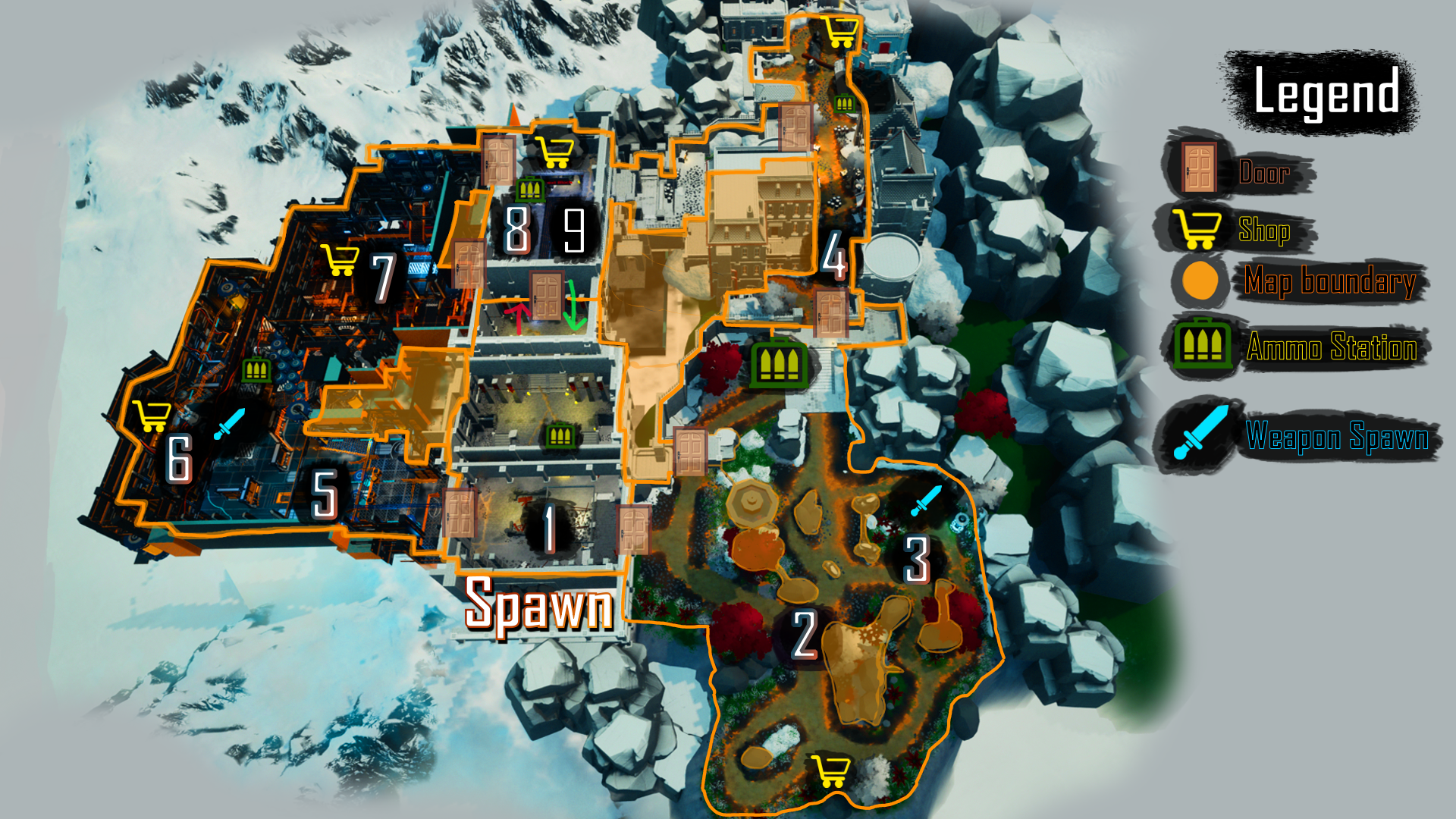
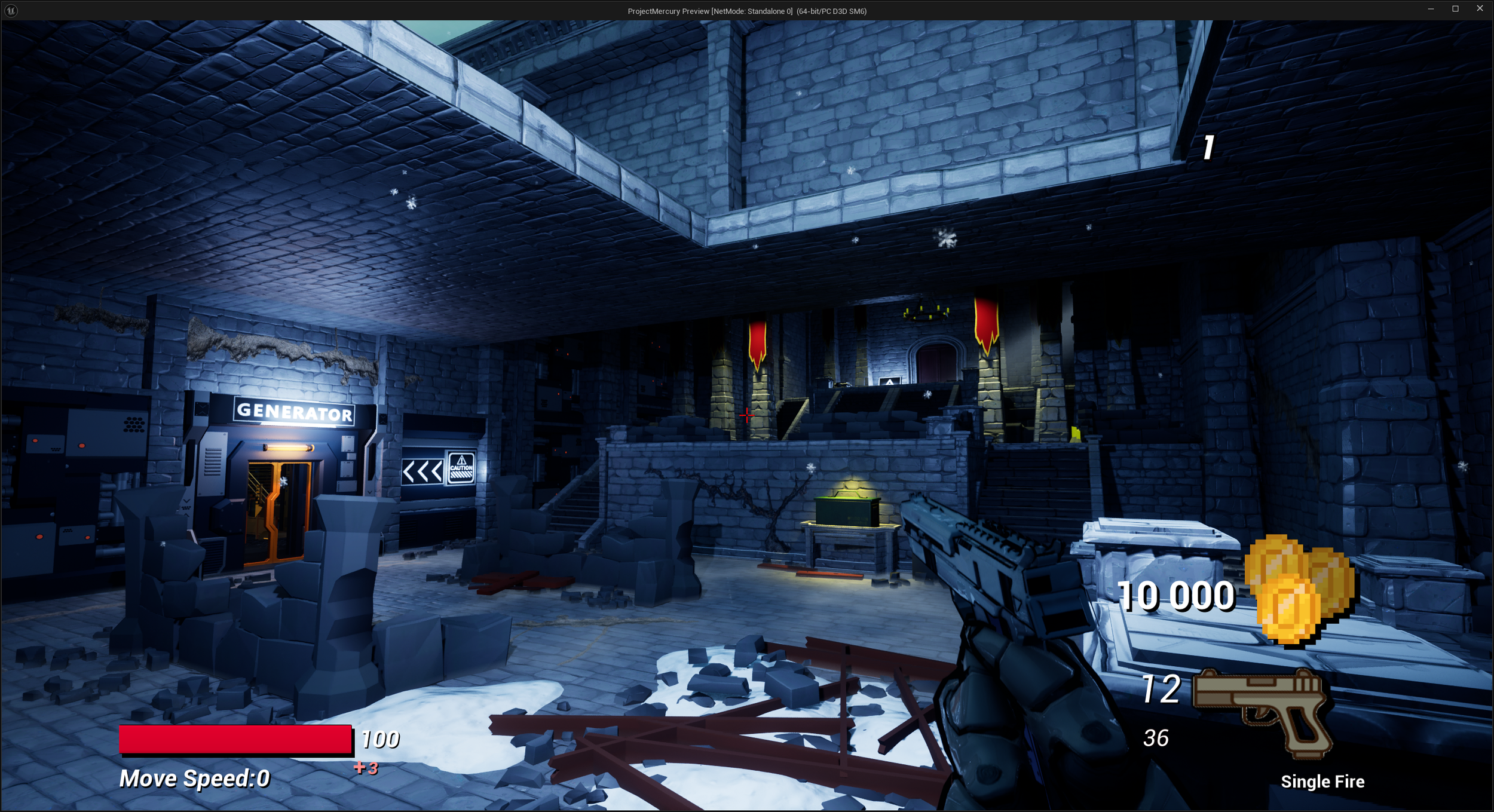
1
Level Start
This is the first thing the player sees when they get dropped in to the game. It presents two doors and an ammo crate, two objects they will interact with a lot during the course of the game, so I wanted to present them early.
The spawn room is designed with enough space to manage early rounds, but can quickly become cramped. The idea is that the player kills enough enemies, to gather money to open the doors that lead to the branching paths of the map.
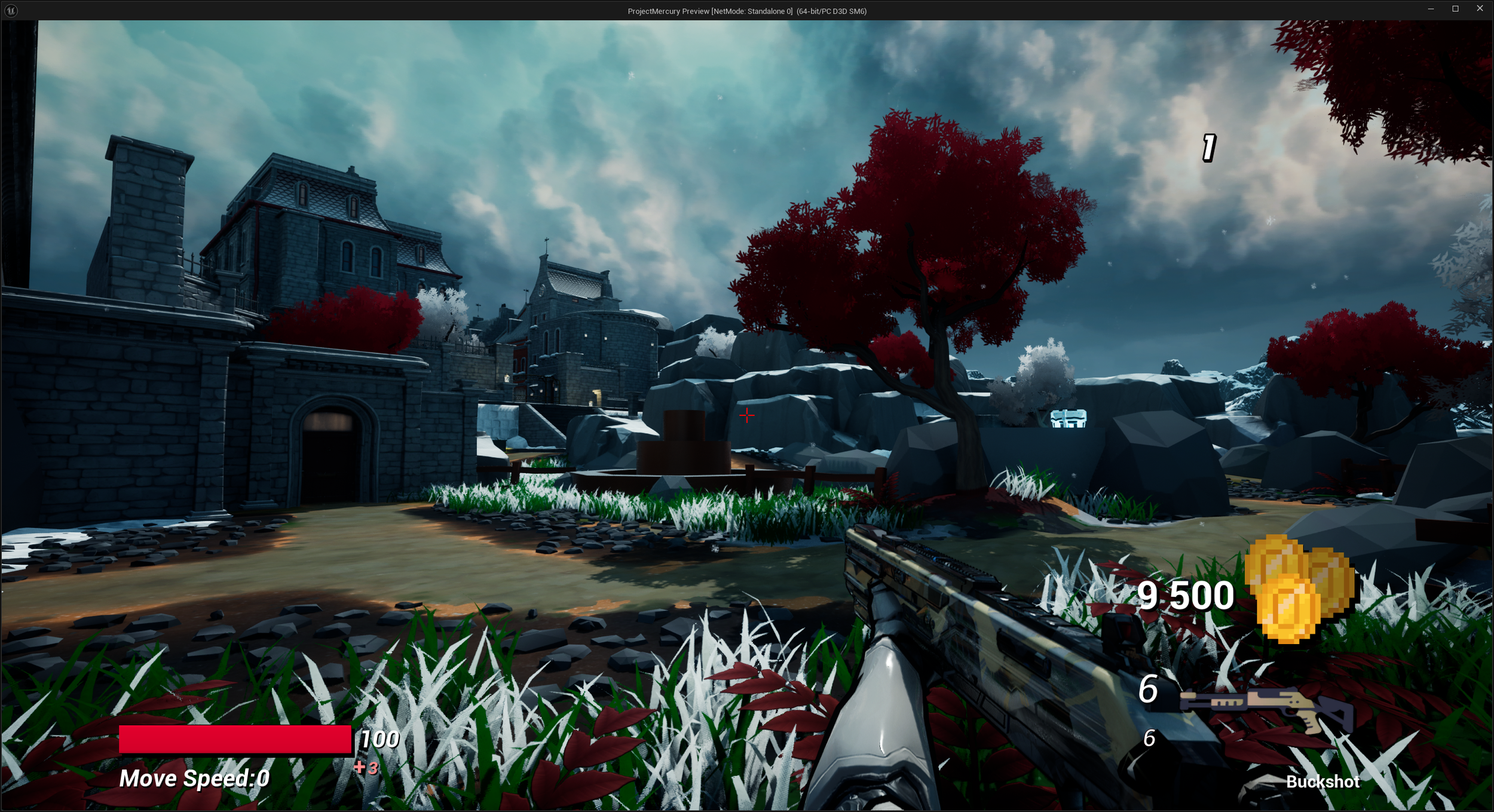
2
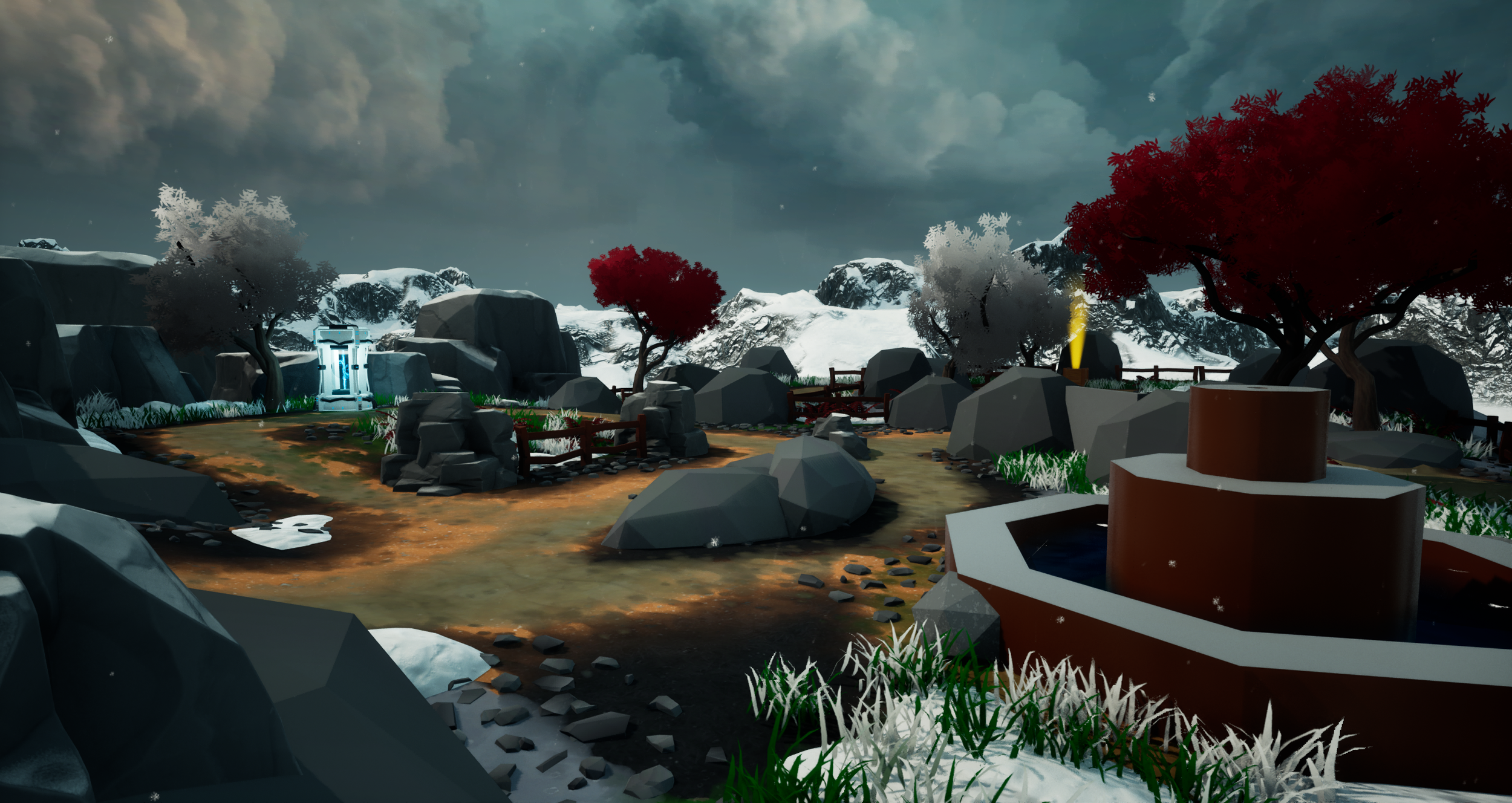
Courtyard
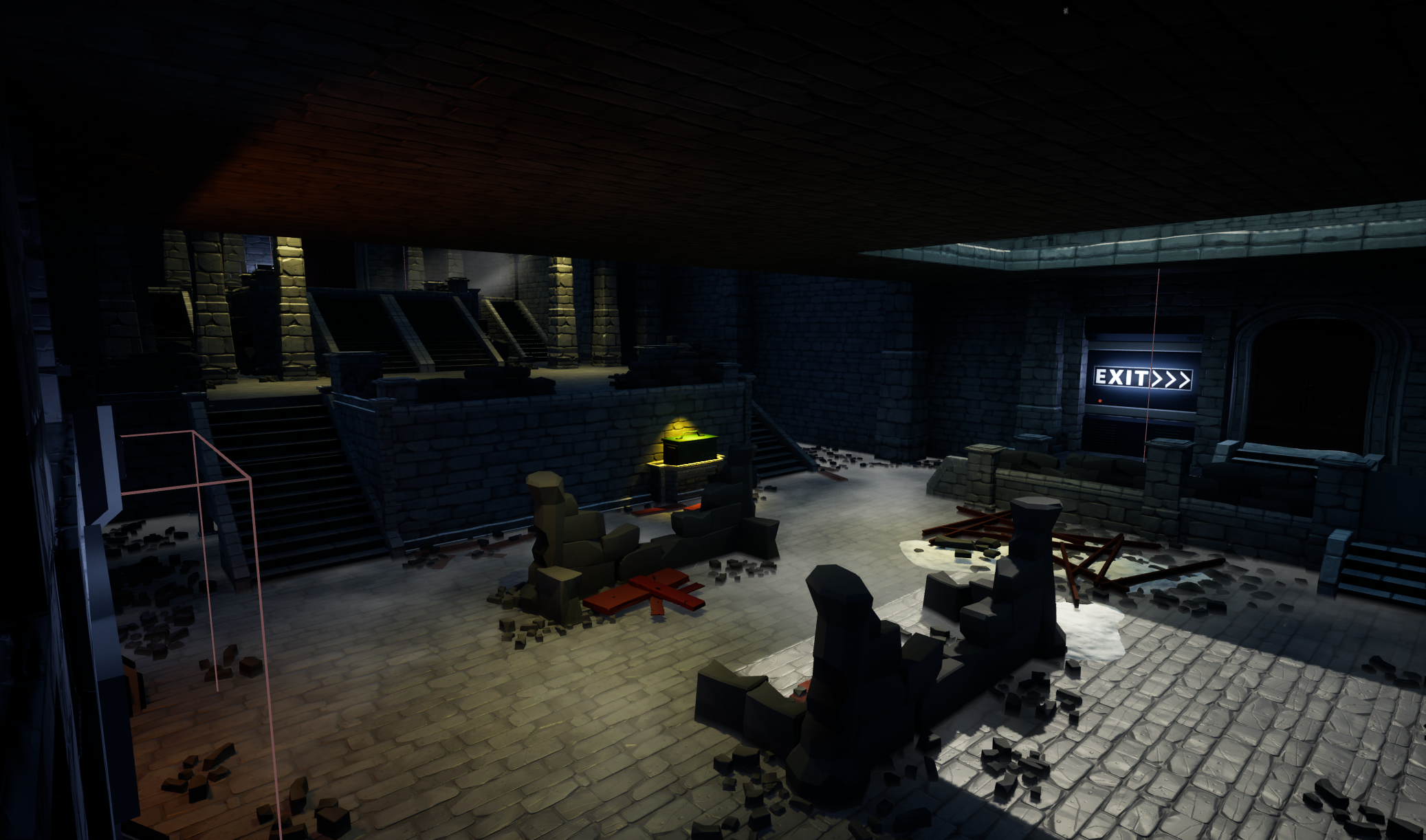
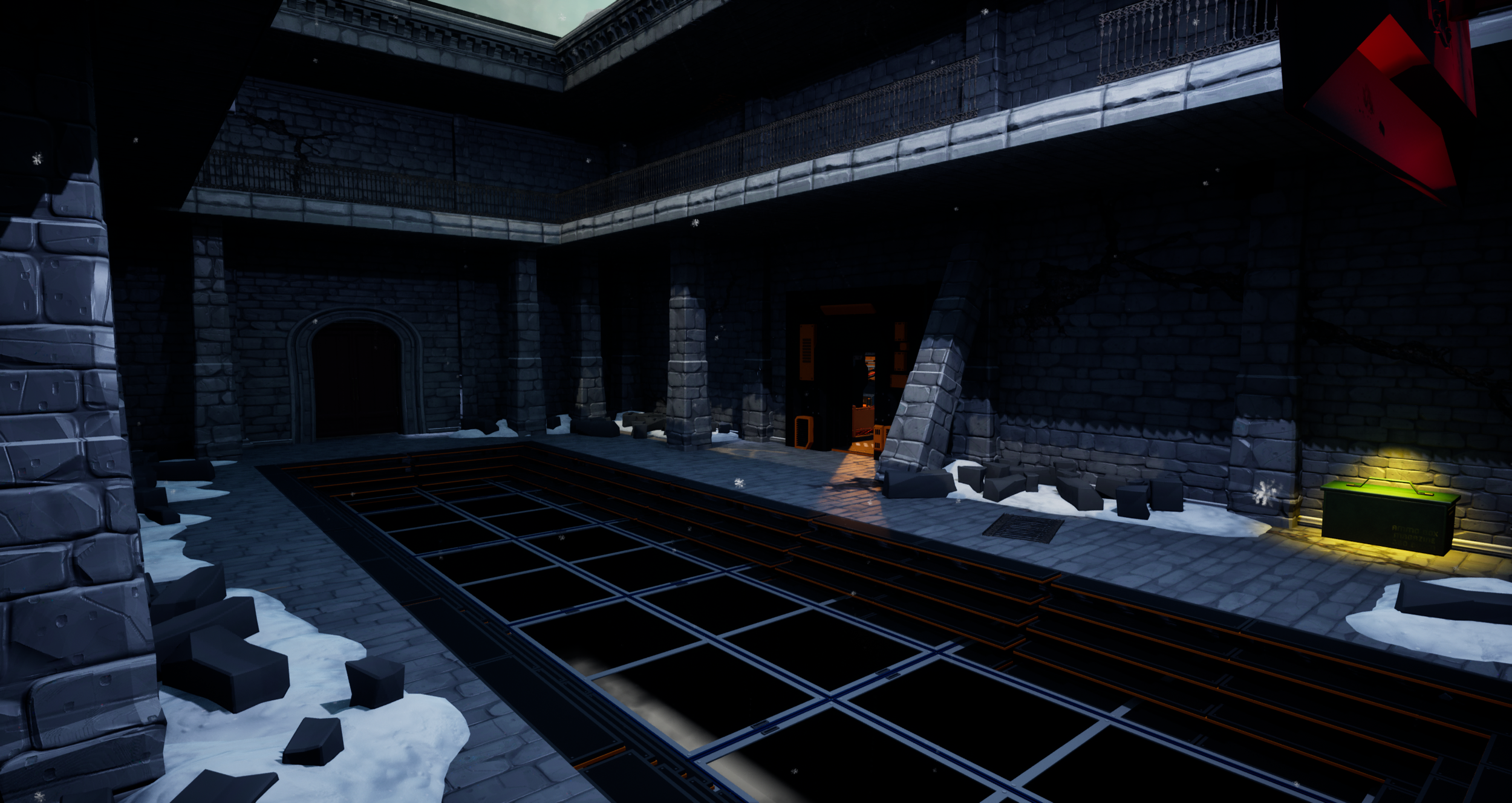
The east door in the spawn room leads out to the courtyard. It’s more open than spawn and features one of the weapon unlocks, an ammo box, one shop and a connection to the village northbound.
The standout features of the courtyard is the deliberate space planning and overall layout, the outer walkways of the courtyard are safer to traverse but if you’re intending to go somewhere else on the map, it’s not the fastest route. The courtyard allows the player to get a sense of risk vs. reward when moving on the map.
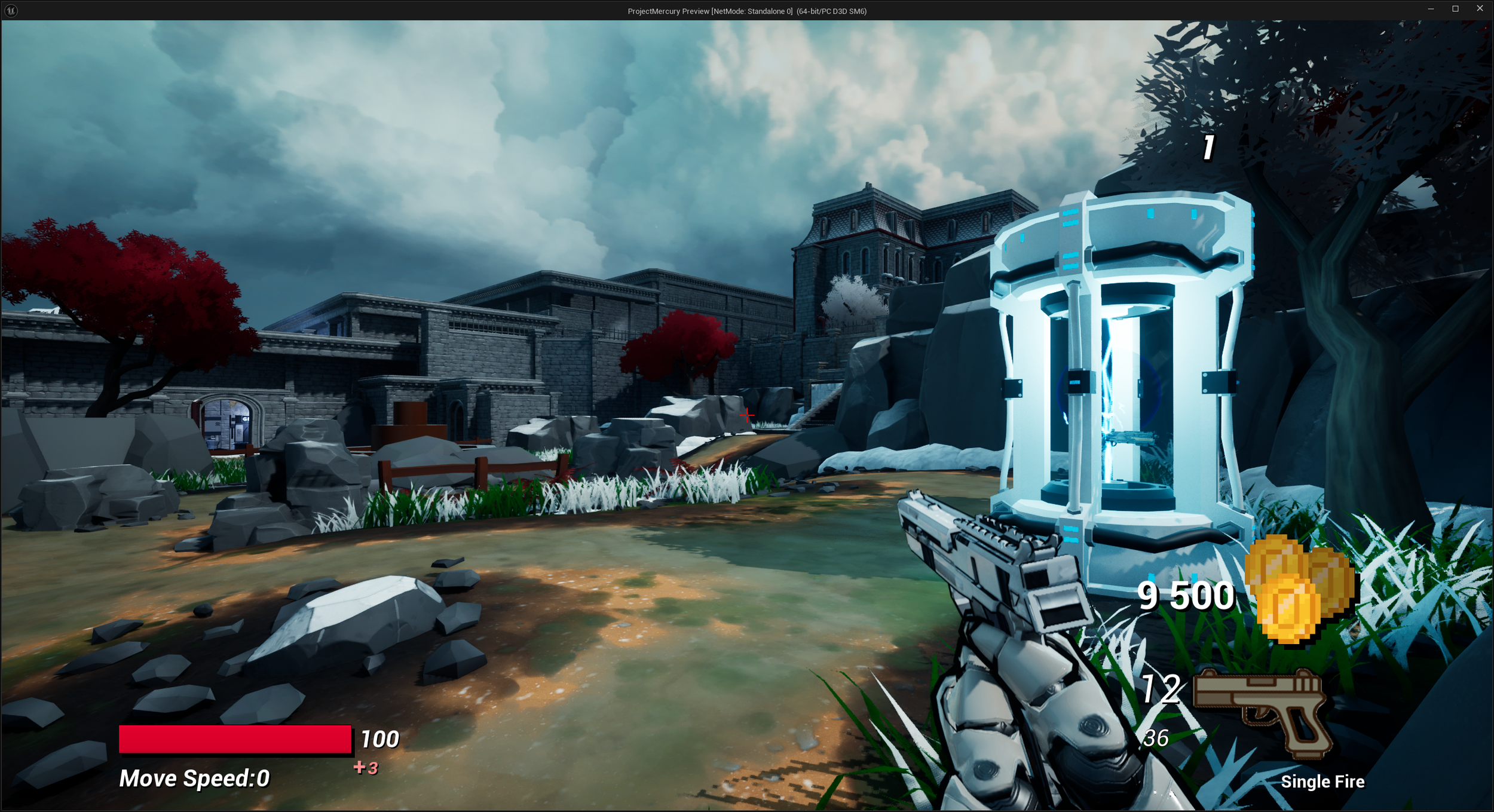
3
Courtyard weapon spawn
The courtyard weapon spawn is a lot more open than the rest of the area, it’s designed that way because the player needs to stay within proximity of the soulbox to charge it, meaning most of the time they will stay in one spot for a while and risk getting swarmed with enemies.
It’s also good contrast in spacing compared to the rest of the courtyard, and being on the outer edge of the area it’s also the furthest from any exit so there’s pros and cons to playing by it.
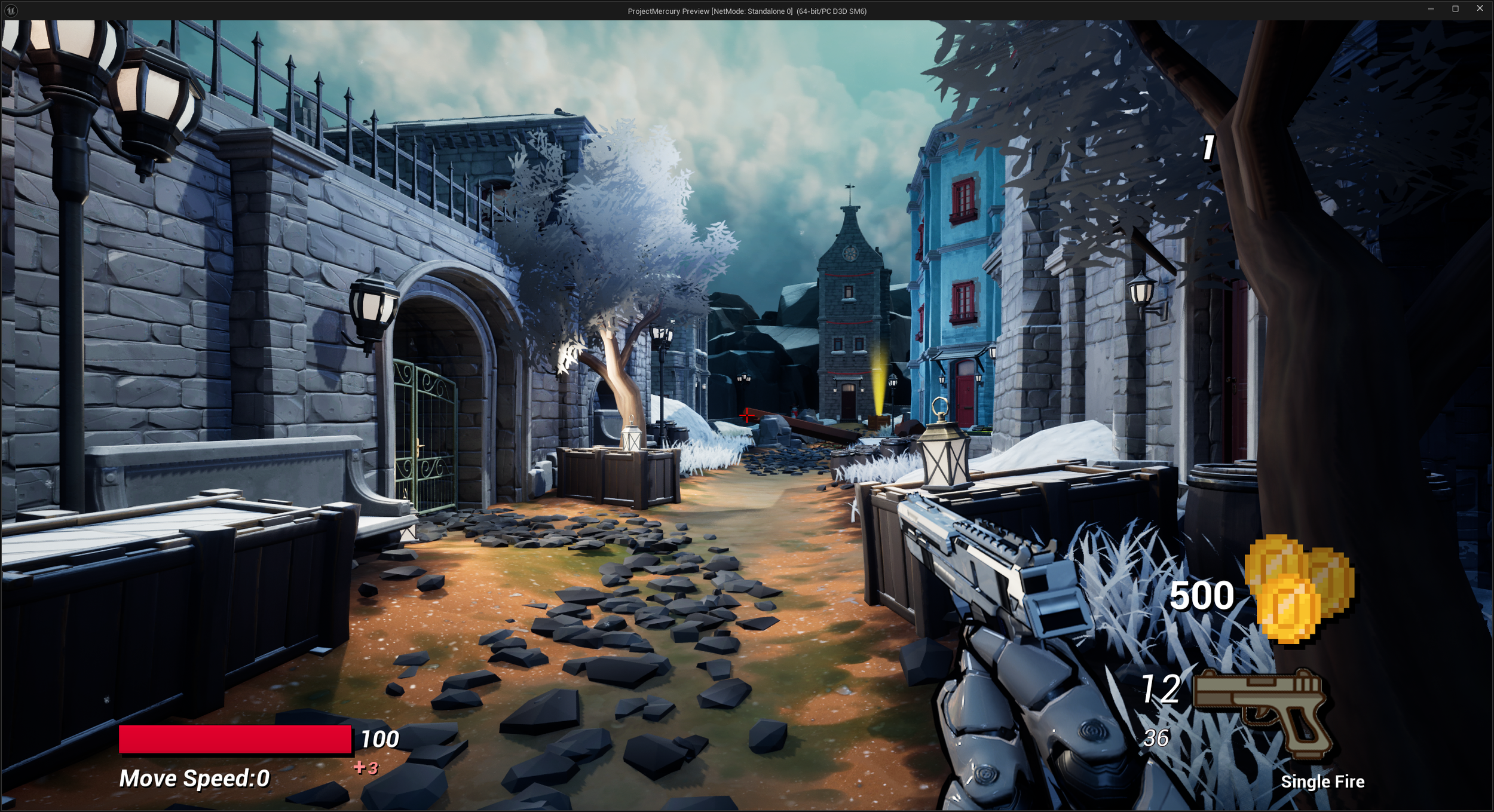
4
Village
The player can reach the village if they head north from the courtyard, or head east from the altar room (screenshot #8). This area mainly serves as a connection point between the courtyard and altar, as it’s quite linear and narrow but also fairly long. It’s a good area to line up a bunch of enemies in a row and mow them down due to the aforementioned properties, as well as the fact that it’s lacking in verticality, so lining up multiple headshots becomes a lot easier.
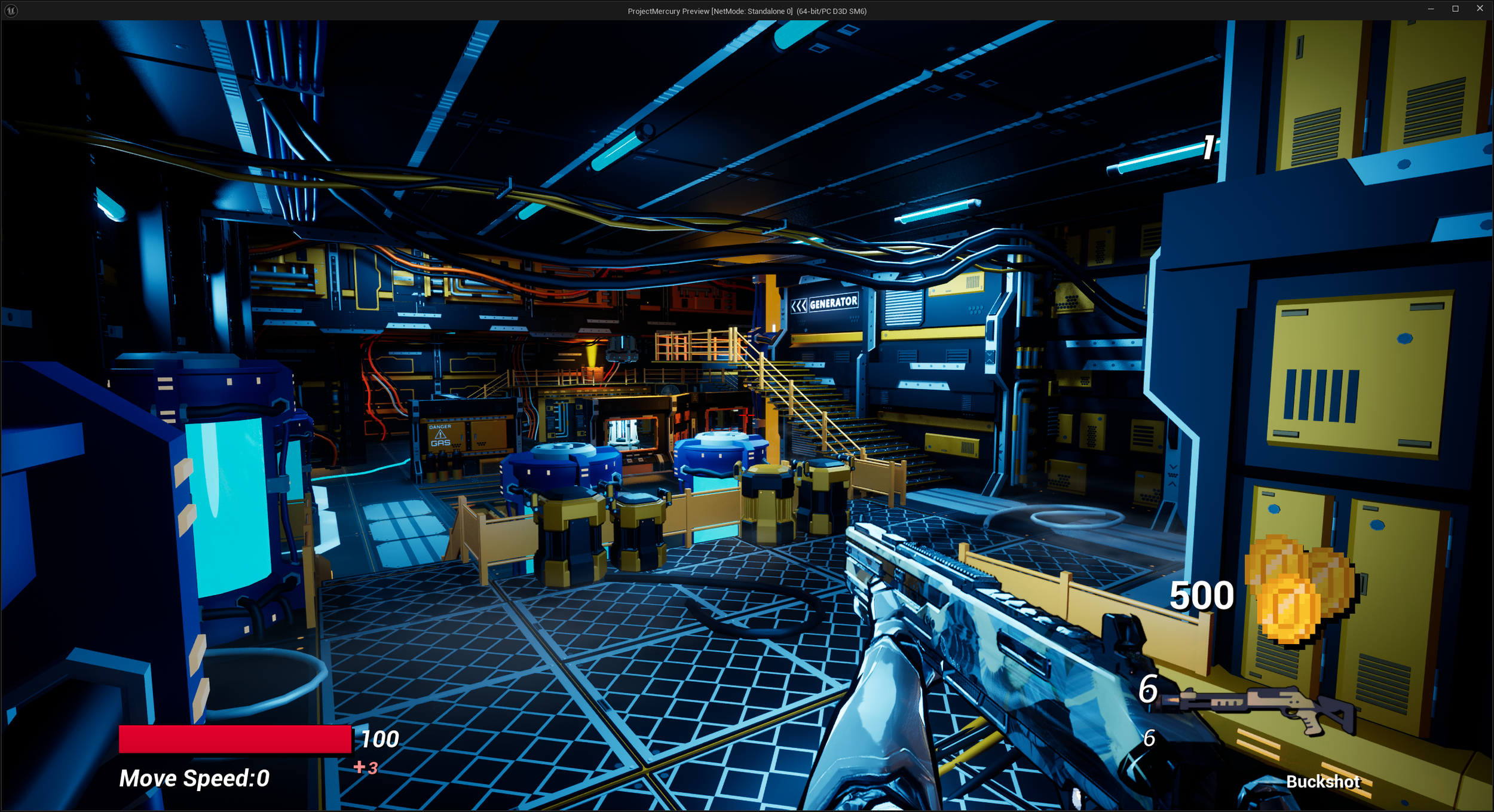
5
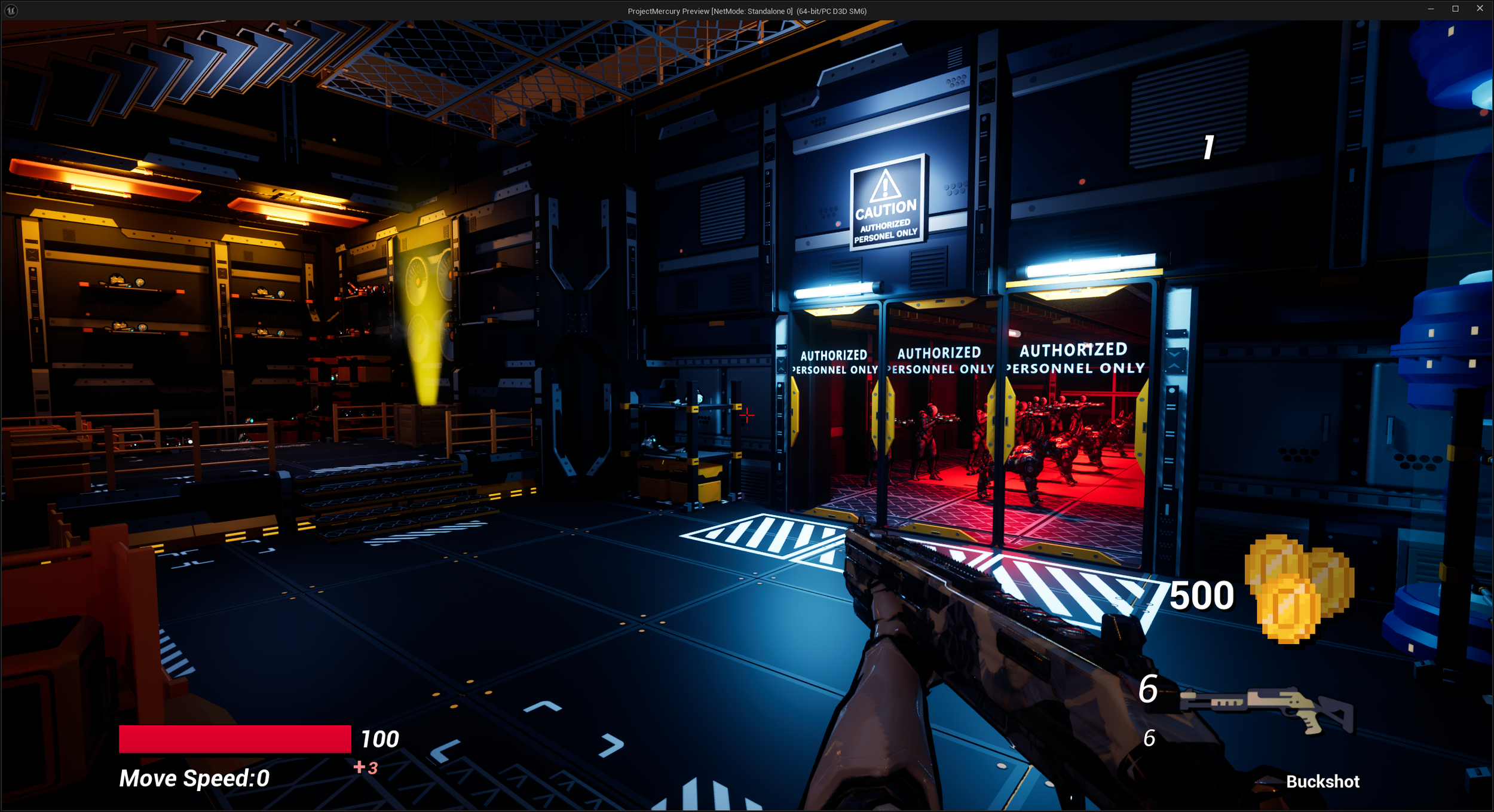
facility entrance
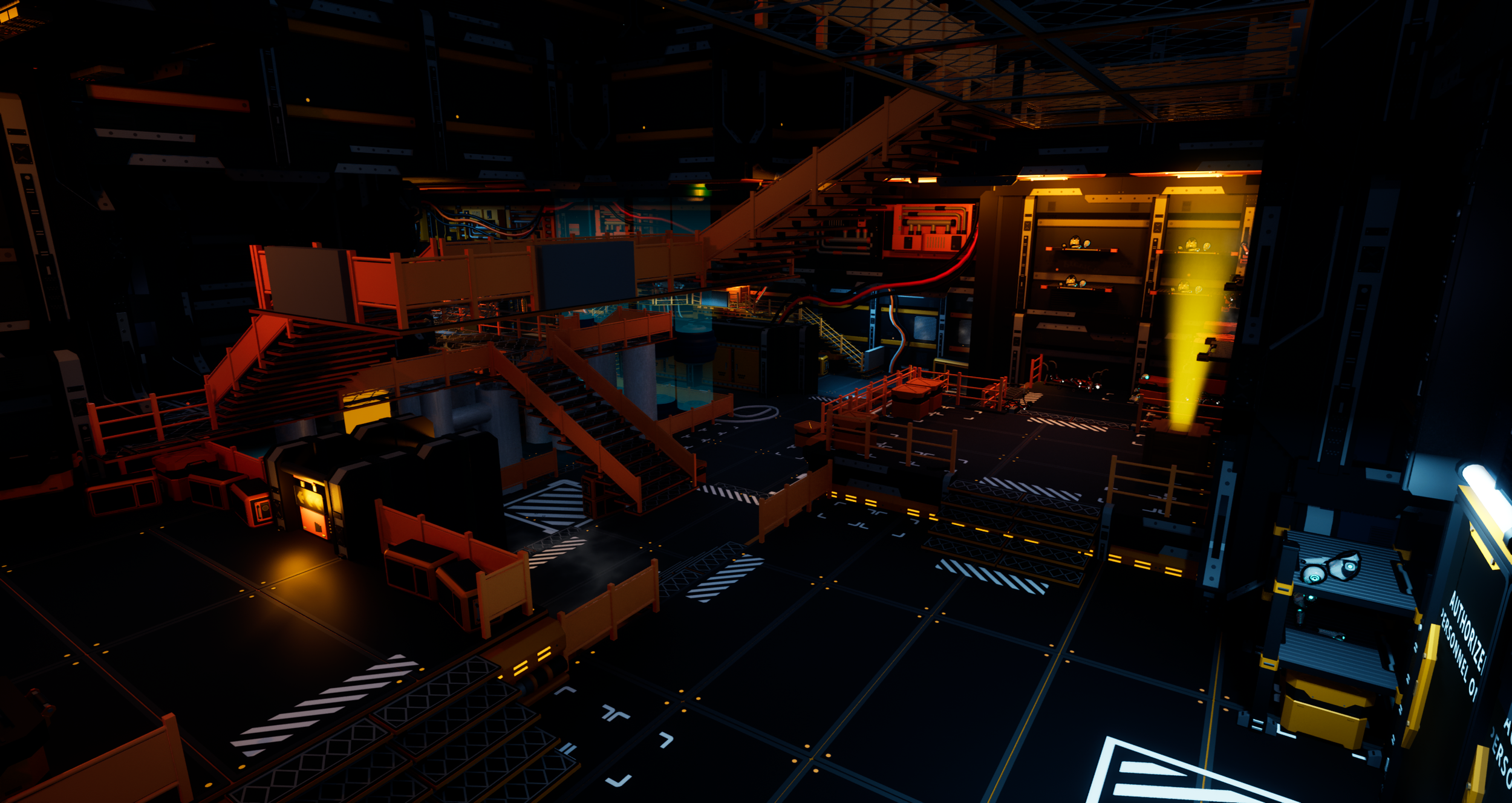
The west door in the spawn room leads to the facility, where the robots are born. The facility is more intertwined with itself, and more claustrophobic than the previously mentioned areas, but it also offers more, smaller connecting pathways which allows the player to effectively feint the enemies.
This area will test the player’s ability to make quick decisions in their pathing as well as reacting to unpredictable obstacles in the form of moving enemies.
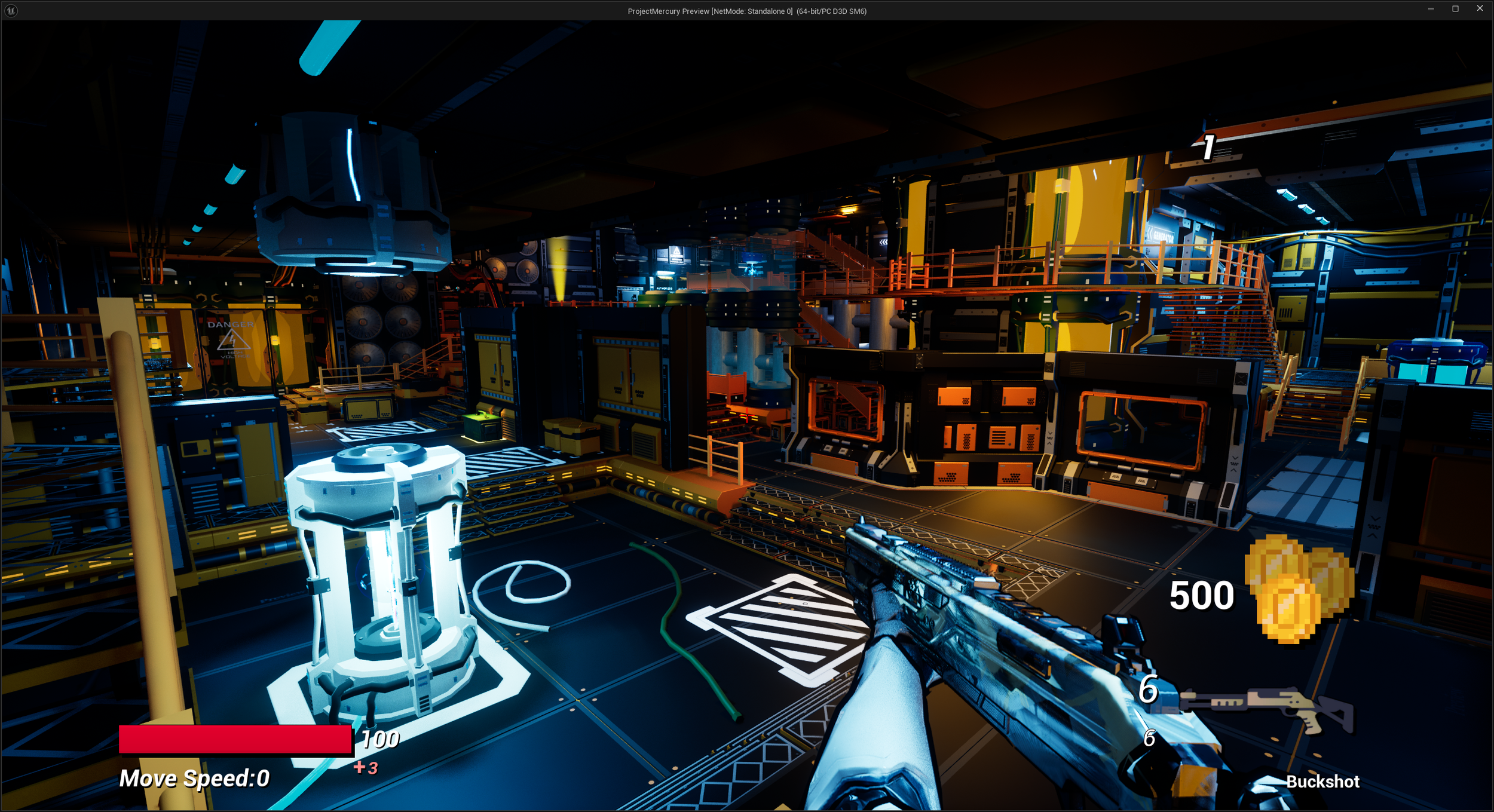
6
Facility weapon spawn
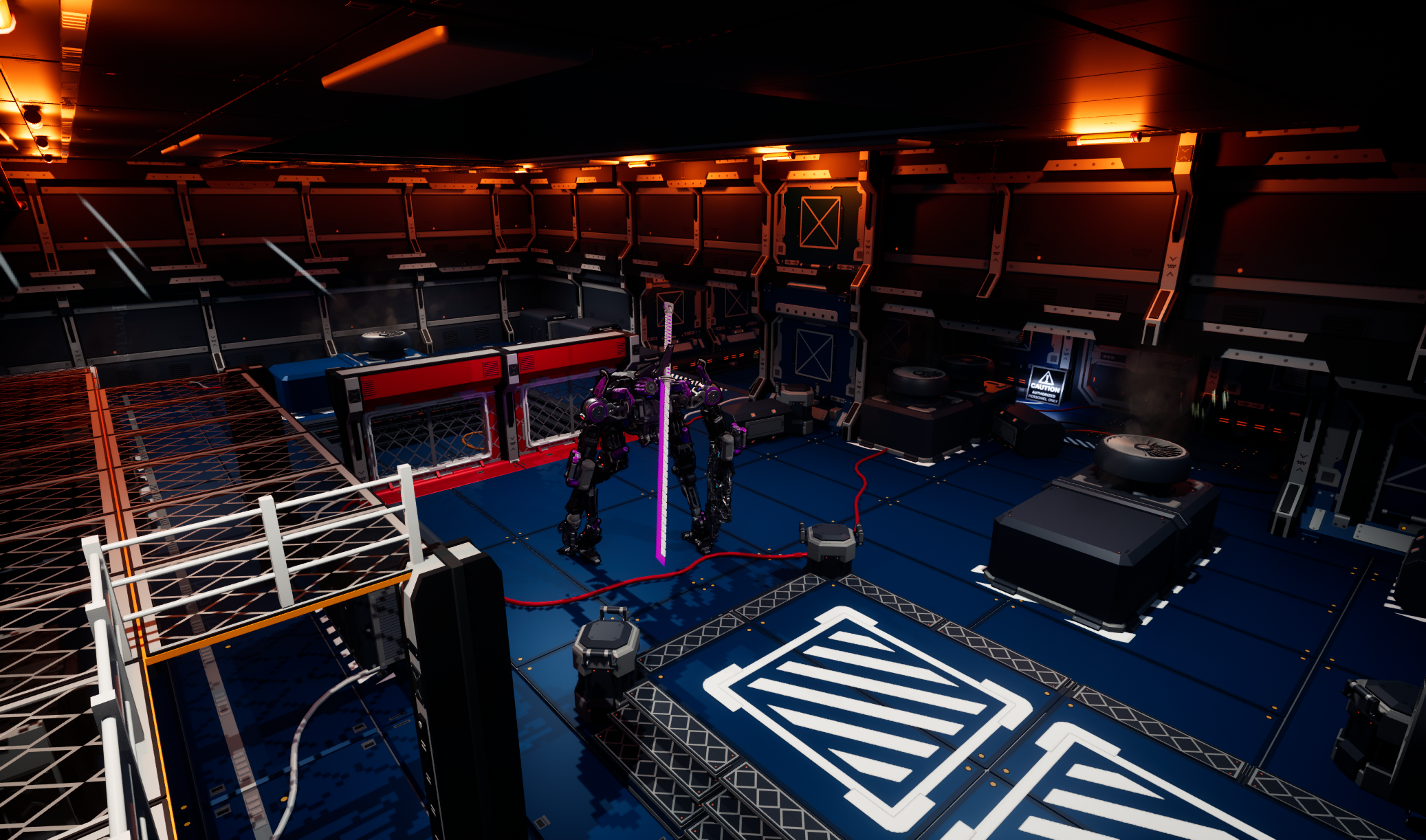
Much like the courtyard weapon spawn this spot is a bit more open compared to the rest of the area, for the same reasons. It’s still a bit tougher to navigate safely compared to the courtyard one, due to the nature of the facility itself being more claustrophobic. You’re not exactly meant to “camp” inside this area as it is, and this place reinforces that sentiment.
That said you have more options for escape at this spot, with 3 exits on the ground as well as an elevated, narrow catwalk, which is meant to give the player some space to plan ahead of where they need to run.
7
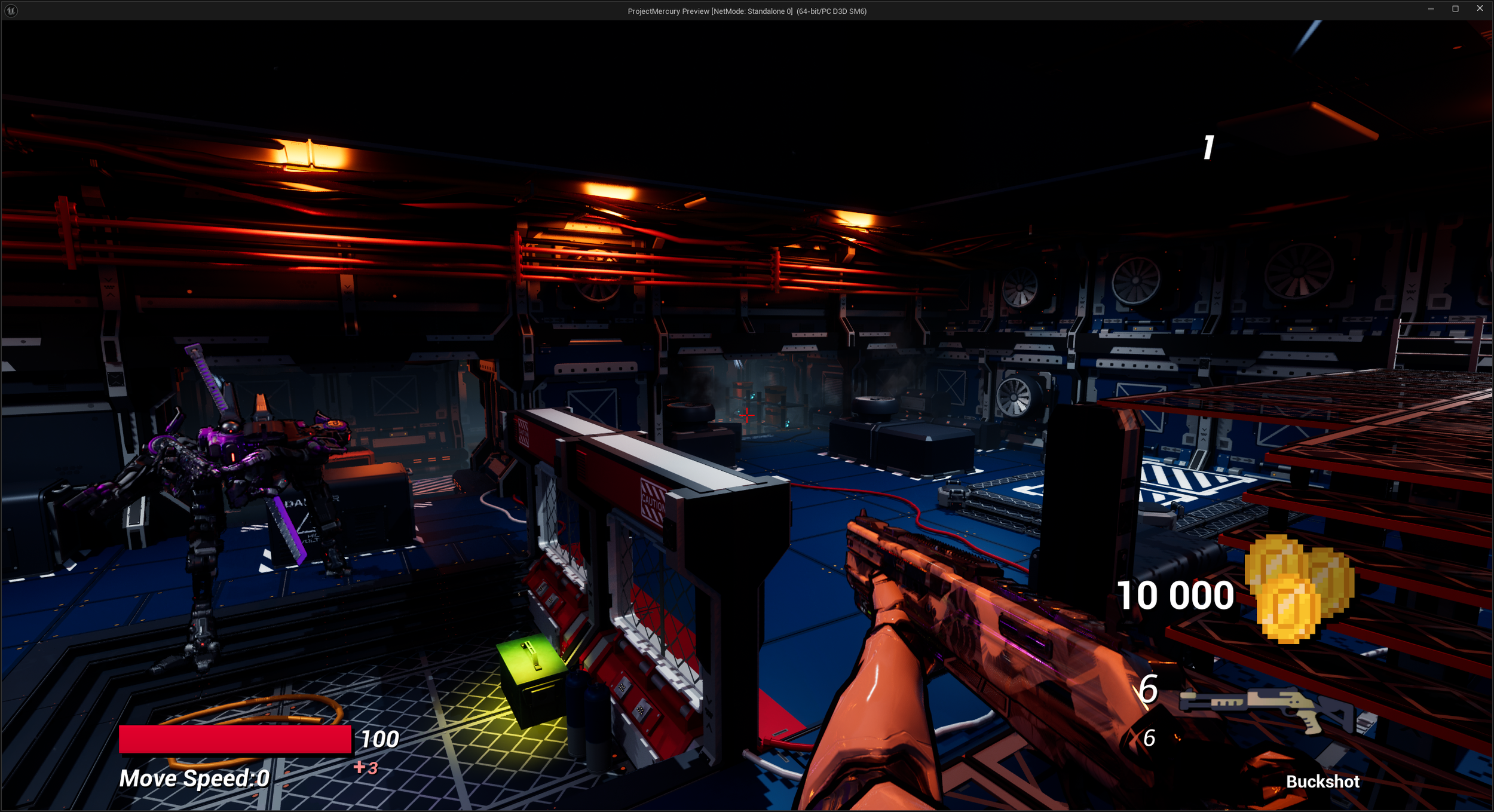
Facility Maintenance area
The maintenance area serves as a smaller, connecting area to the altar room, as well as showcasing some environmental storytelling. It features a good amount of micro elevation, a shop and a plethora of escape options. It’s one of the more safe areas to play around on the map for shorter periods of time, but staying too long is rarely viable because of how quickly it becomes swarmed, due to there being several spawn points here.
There are spare parts for the robots in the left corner and a big window where dormant robots, and robot dogs, are waiting to become activated (not gameplay relevant, but it adds to the environment).
8
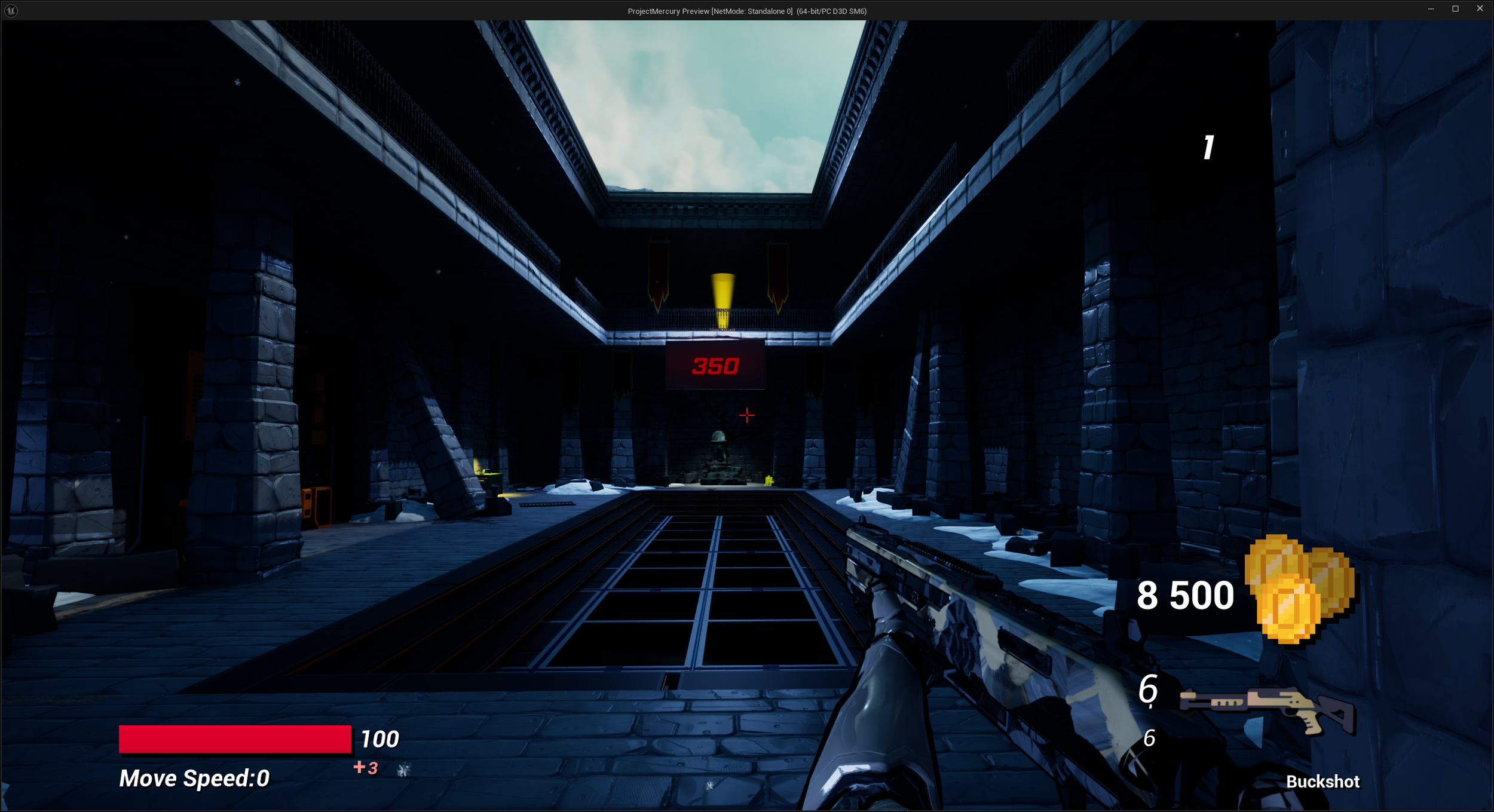
Altar room
The altar room, just north of the spawn room features a one way door that leads back to spawn. The reason this door is one way, is because it adds meaningful map progression as well as a sense of accomplishment once it’s been opened. It’s what connects the northern and southern half of the map and is what creates the Figure-8 flow of the map.
This room also features the weapon upgrade altar, where the player can purchase the unique secondary functions that I showcased earlier, and lastly it’s where you trigger the boss fight once the red number on the monitor has reached 0, which decrements every time you kill an enemy. So it’s safe to say this area carries A LOT of importance for the whole experience.
9
Boss room
The boss room lies beneath the altar room, below the glass floor. It’s a fairly small arena trying to follow the themes of the facility both visually and in scale.
This room features one ammo box, and a generous amount of cover and smaller passages that the player can snake through in order to get a tactical advantage versus the boss, Project: C.A.R.M.E.N.
I wanted to make the player feel small versus the boss, but not entirely outclassed, and I think the level design here is what allows for that. The player has spaces where only they can go and make C.A.R.M.E.N. have to re-route. It creates for an entertaining cat and mouse gameplay segment within the fight!
Level design
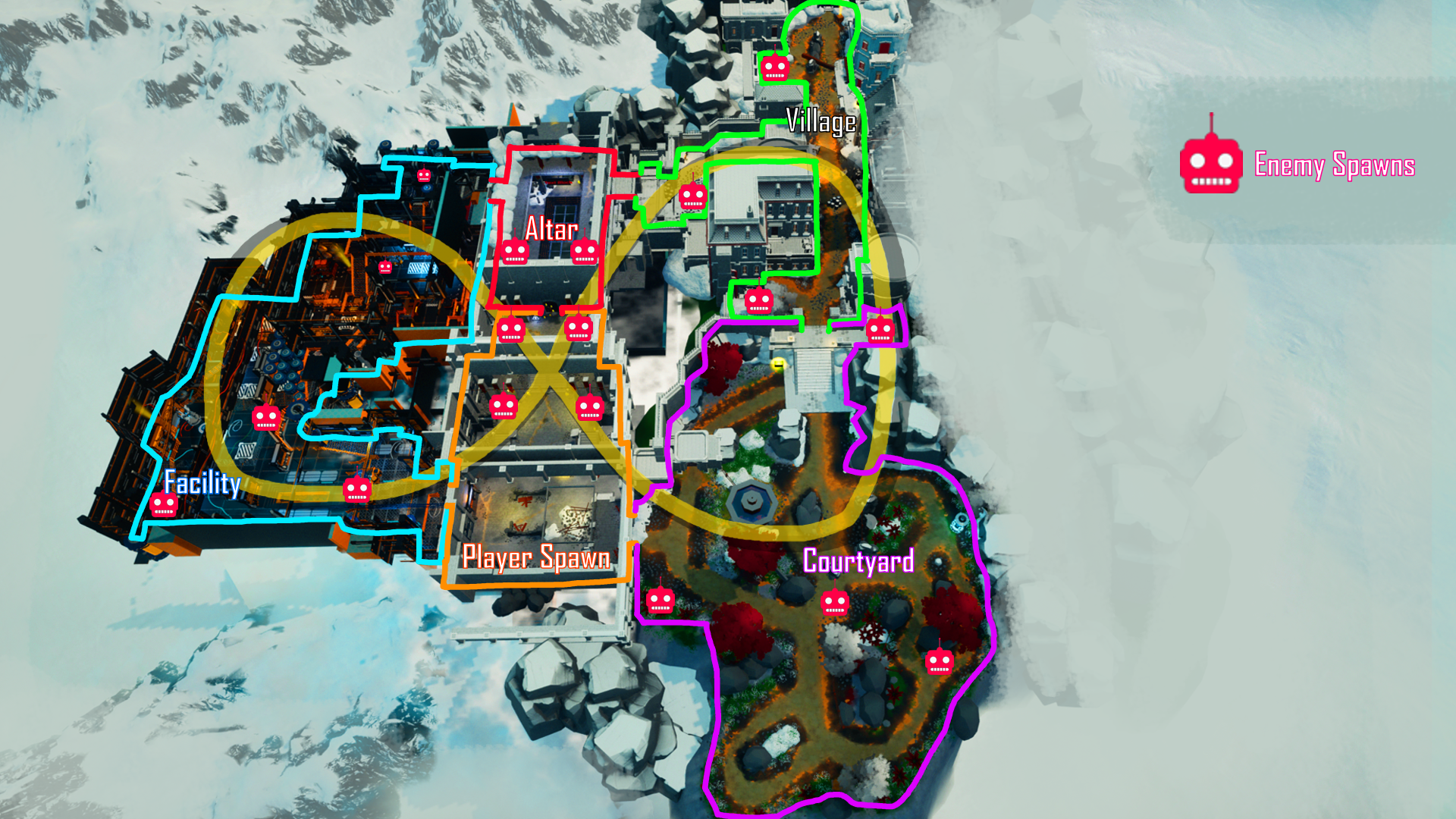
Different zones of the map, underlined by the Figure-8 design philosophy
Zones
The map is created on a Figure-8 foundation and divided in to distinct visual zones to help the player create a mental map, as well as creating good flow and helping the player to not get lost.
What I mean by Figure-8 is that the map sort of "loops” on itself in its layout. If the player just walks along a path, the level will eventually lead them back to the initial location.
The reason I chose this design approach is to create flow and make controlled funnel points, where the player can expect more enemies per square meter. Certain areas become more risky to traverse due to the tight spaces, but also allow the player to quickly dispatch many enemies at once. It allows for moments where split second decisions matter, the quicker route will get you from A to B faster, but you’re also risking getting caught in a tight space.
It’s what makes the level design feel engaging to play, the player is being tested on their judgement to choose the right path in any given moment. It feels good to overcome and is naturally integrated in the rule of “30-seconds of fun”.
The zones aren’t purely for visuals however, they help control the map flow through spawn points that only become active once the player has entered the respective zone.
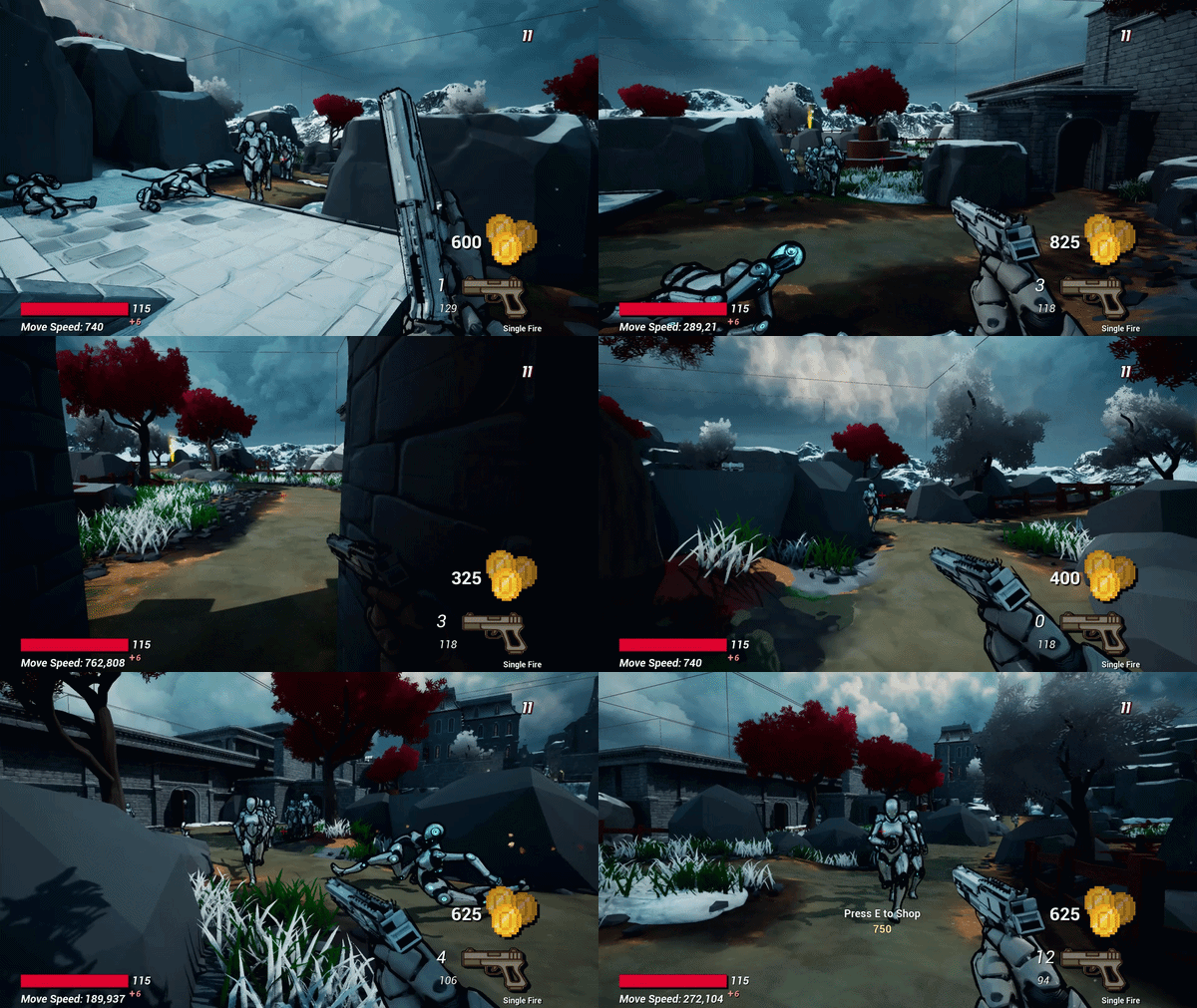
Example of tight space situation
sPAWN system
As previously mentioned, the map is split up in zones that control which spawn points are active.
Not only is this good for removing the downtime of having to wait for an enemy across the map that just spawned in, it also makes it so the game doesn’t softlock. Without this system in place, enemies would spawn in locked rooms, and if the player can’t afford to buy the door, they can’t kill the enemy and progress through the rounds.
The script is more or less just a Byte variable that updates whenever the player moves between trigger boxes. It then checks which spawn point actors are overlapping with the zone, and allows for those points to become active until the player moves through another trigger box.
This same setup also makes it super easy to build upon the different zones in a visual manner, for example if you wish to update a post process volume, fog density or the overall brightness without tinkering with a bunch of lights, you can just update those settings with an enumerator switch in blueprints.
Environmental spacing
Every good horde shooter is deliberate with its space, how tight should important areas be? Where does it become more open? What does the player have to consider when going from one place to another? Having answers to these questions in the level makes for an engaging play space.
I think I managed to create varying layouts using these questions as a pillar of the level design. The 2 main areas, the Facility and the Courtyard heavily uses these fundamentals and makes for engaging moment-to-moment gameplay.
During playtests, people were caught in the tighter areas when they were playing greedy or too aggressively, which is exactly what I wanted to see. Returning playtesters would become better at analyzing the more unforgiving spaces, and would choose alternate routes/become better at clearing out the rougher areas before proceeding.
This player behavior shows to me that it’s a map that can be learned and mastered by players, and it is incredibly gratifying to see as the level designer.
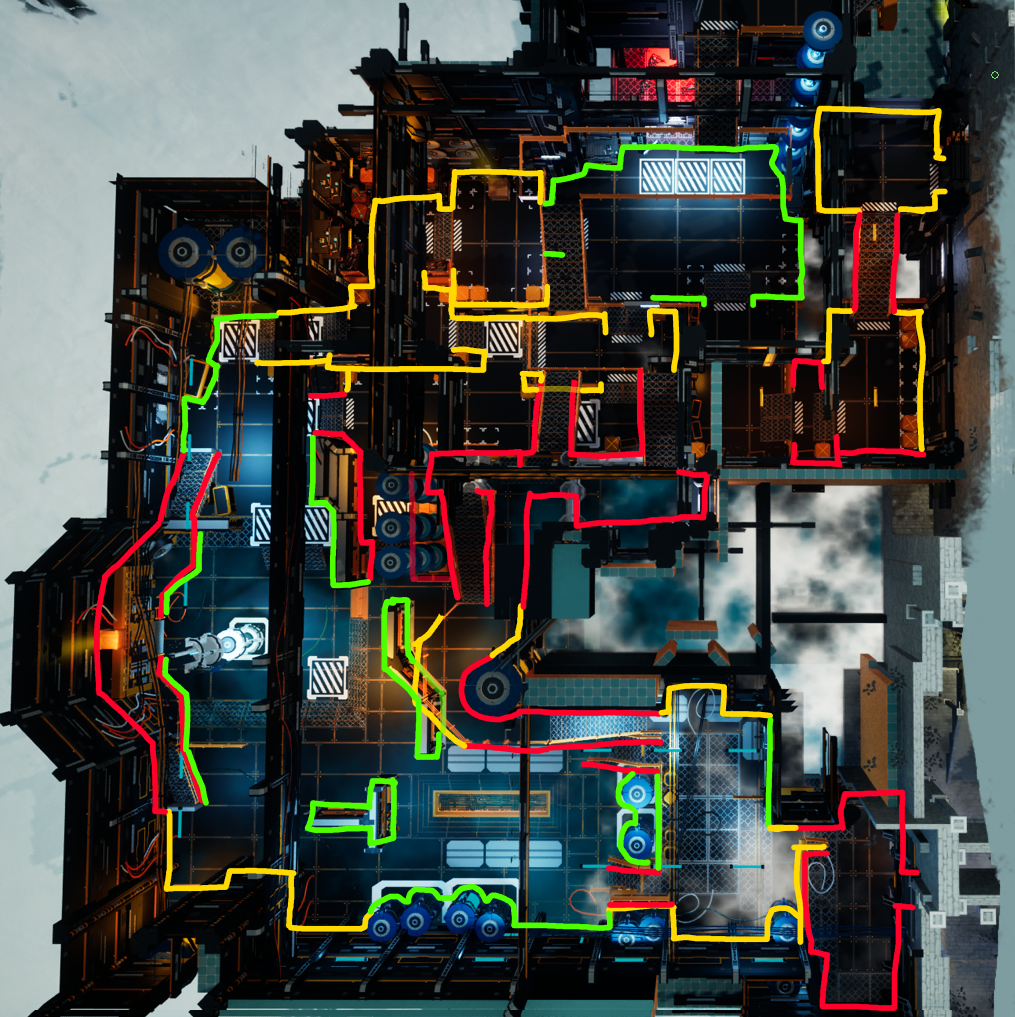
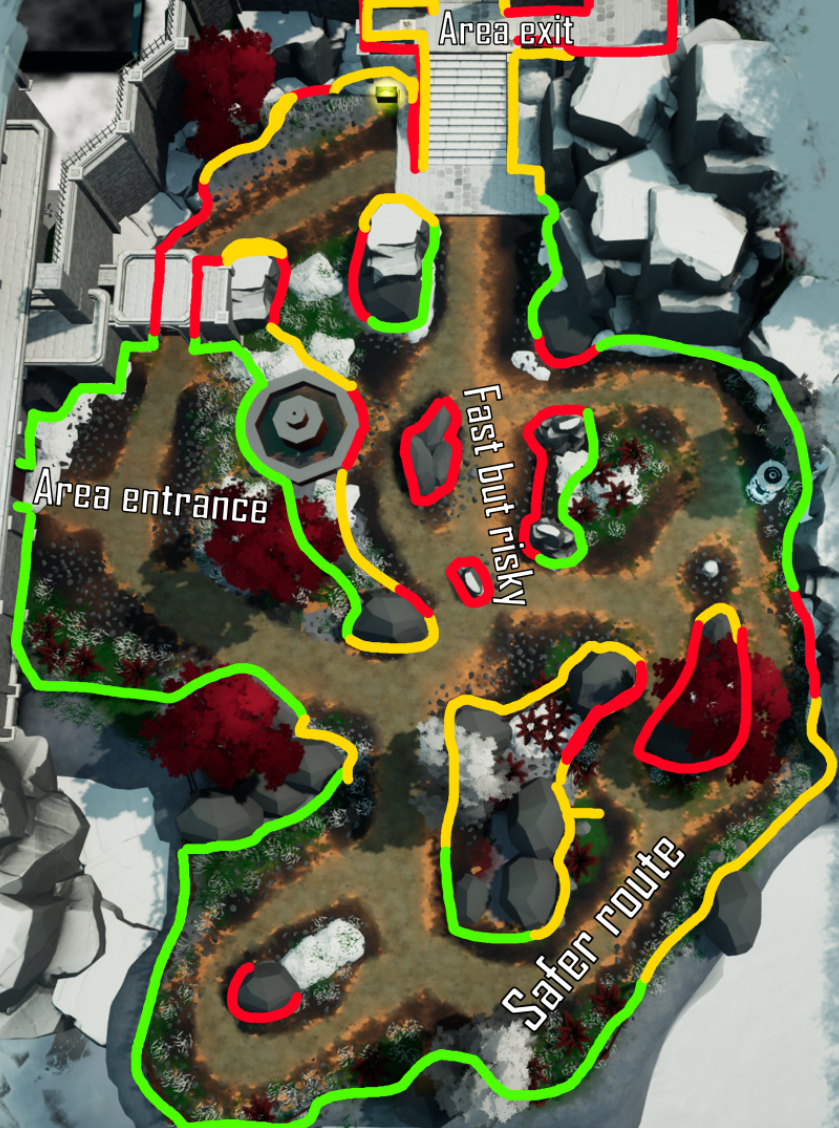
Green = Generally safe
Yellow = Generally risky
Red = Generally dangerous
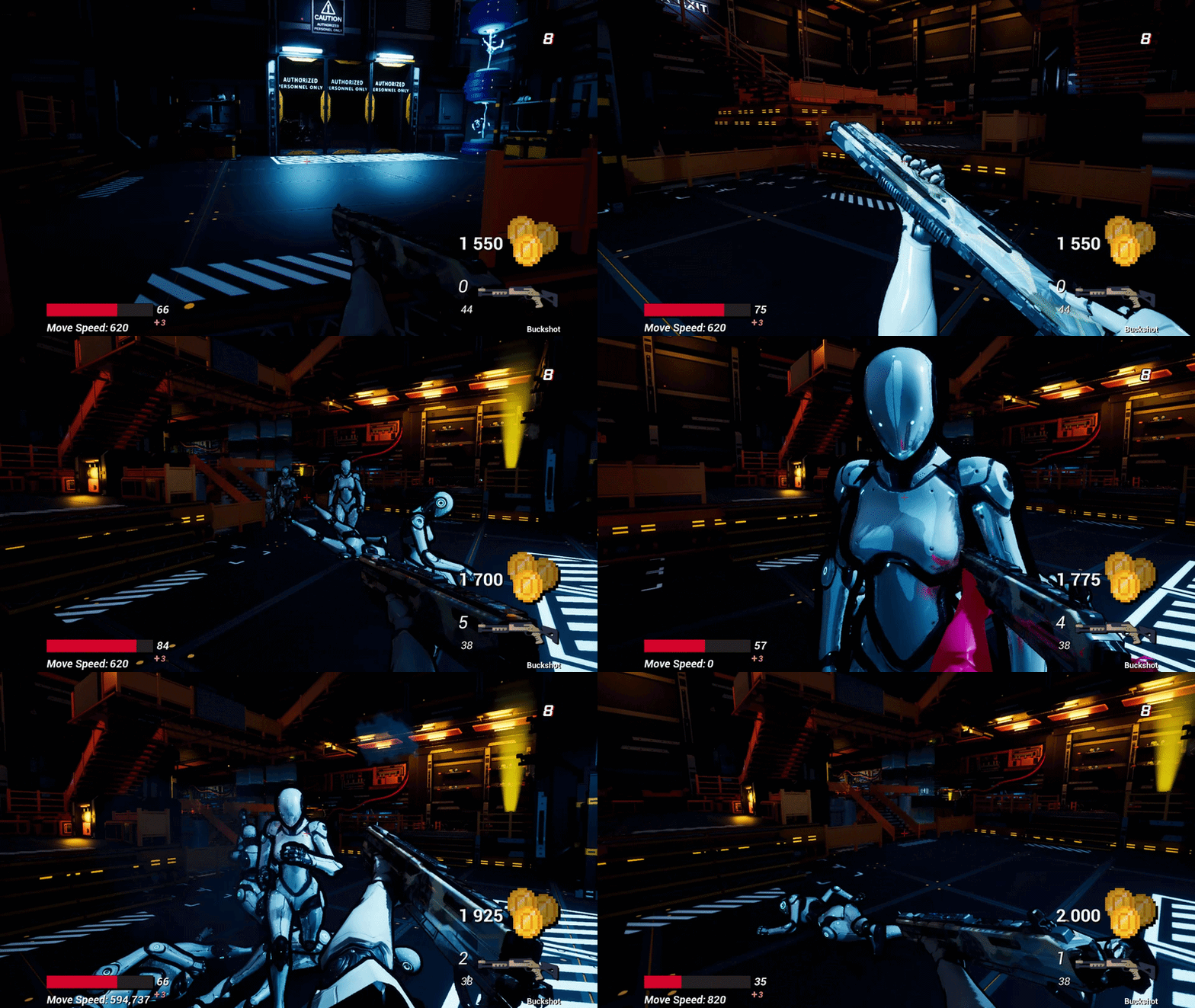
Using the space to funnel enemies for easy kills
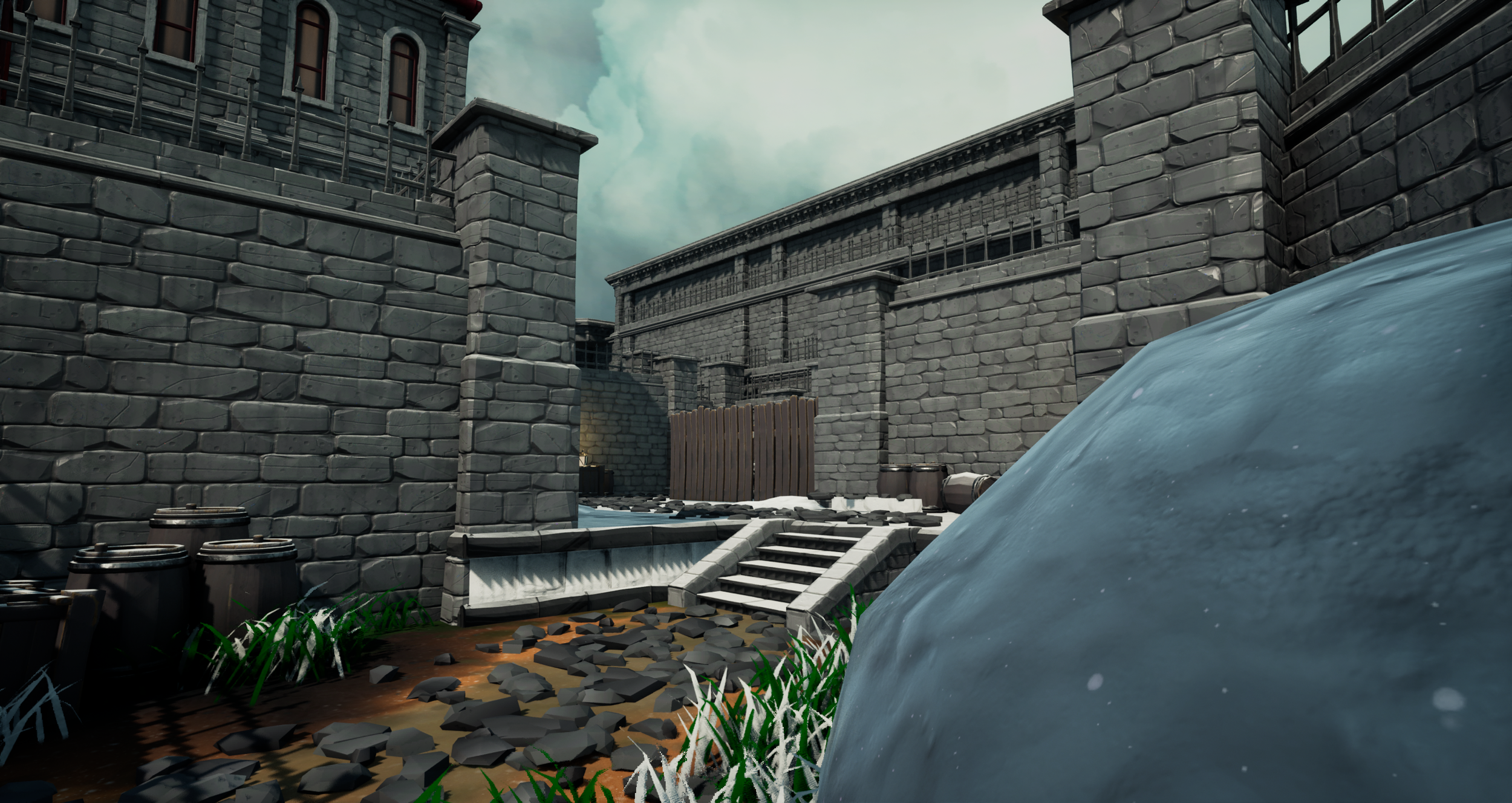
To make an ending for a roguelike
I wasn’t originally planning to make an ending for this project, I just had the idea to make an endless survival experience. But that became kind of dull, as having infinitely scaling enemies became a death sentence in the end regardless of skill or items possessed.
So the next step would be to try a bigger, more intimidating foe, which you could try your item build and skill towards. It also just becomes a natural goal and something to prepare for on subsequent runs, and maybe you want to get the satisfaction of killing the ending boss without any items what so ever?
I also just think walking away from the experience with a victory feels better than walking away because you grew tired of the game and wanted to do something else with your time
I decided to keep the boss low scope in mechanics as it was at the end of the project and it was unexpected that I would work on something like this. I think it works decently as a spectacle thing to end the game with, especially when he jumps down from the roof and breaks the floor to reveal a room underneath.
If I had planned more for the boss from the start, I probably would have given him more attacks and more advanced behavior. Make him more of a boss fight and less of a stat checker.
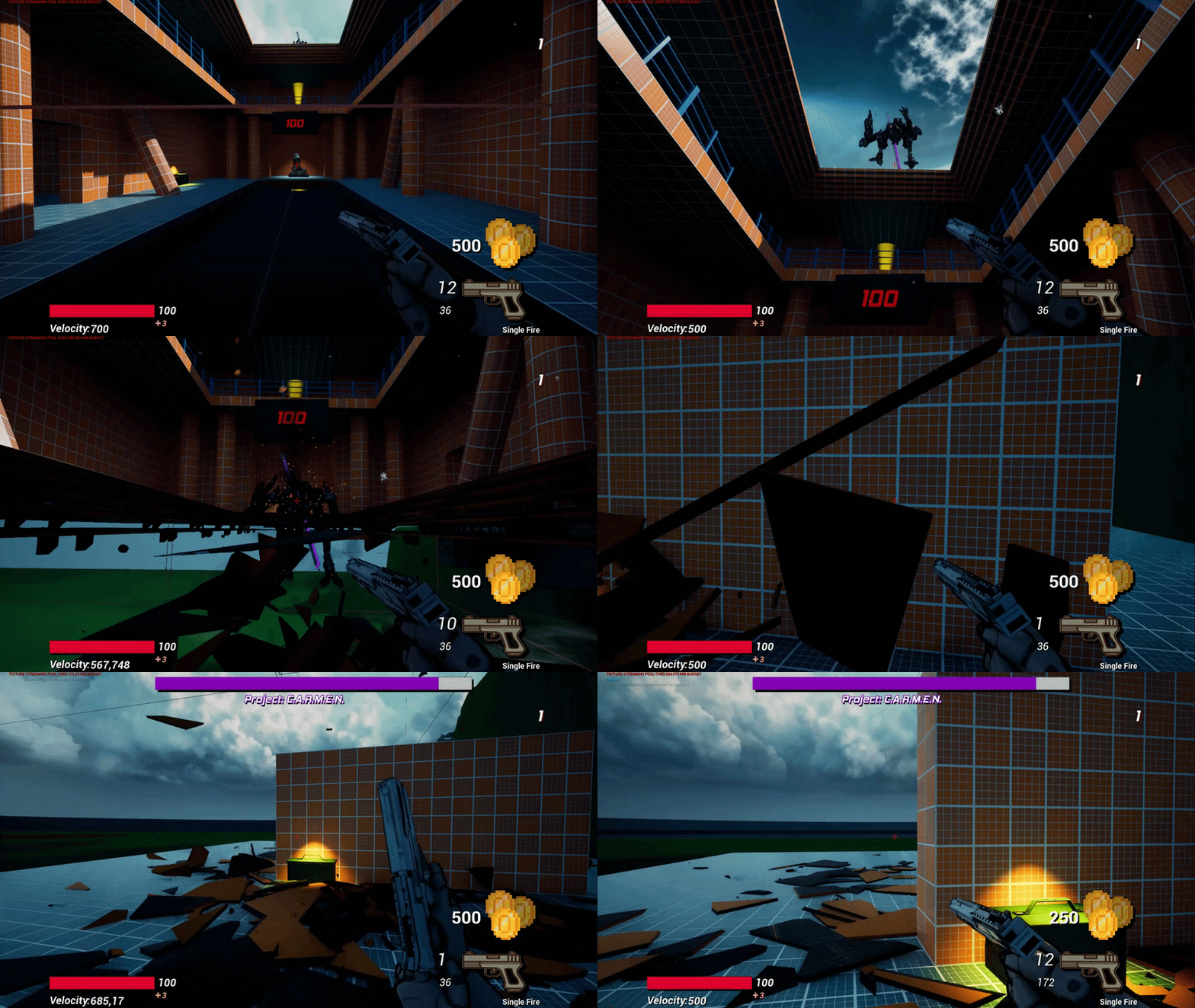
Blockout of boss room and level sequence
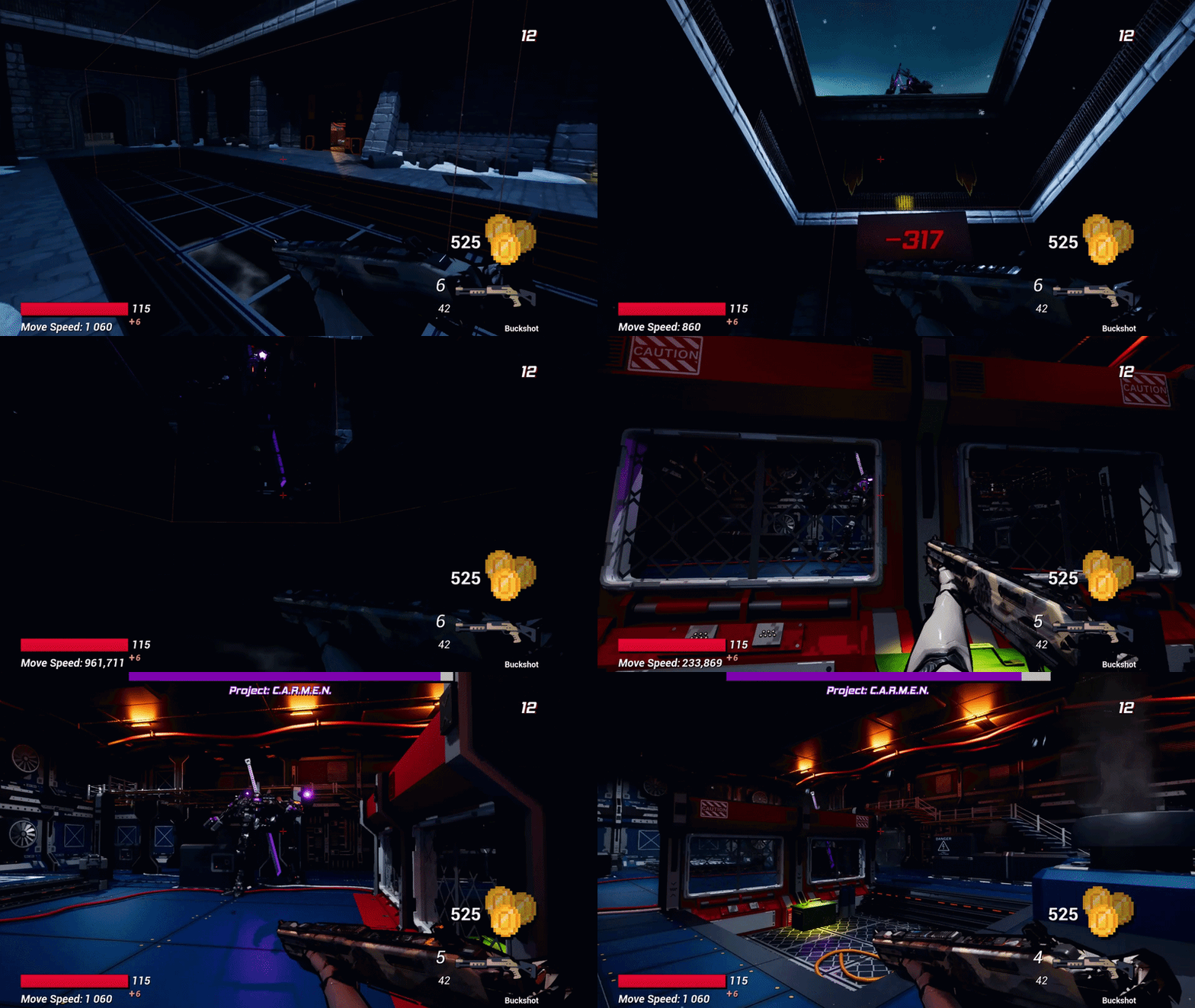
Finished boss room with glass floor breaking
Boss fight
No sound*
Reflections
This project was an absolute blast to work on, and very much opened my eyes to more technical level design and system design.
If I had to estimate I think it ended up being 70% of the time spent on scripting/making systems and the remaining 30% on creating the level. In spite of the time split, I still think the level ended up being super cool and definitely fulfilled my vision of a fitting horde shooter map, with its Figure-8 layout.
The only thing I wish I did more of was level interactables, the doors are cool and add to the progression as well as economy of the game, but it would’ve been cool to include more interactable objects in the level to make it feel more alive.
I’m super proud of this piece and I feel like I’ve created a genuine FPS experience and not just something for show!